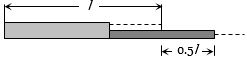
In order to quadruple the resistance of a uniform wire, a part of its length was uniformly stretched till the final length of the entire wire was $1.5$ times the original length, the part of the wire was fraction equal to
Diffcult
Download our app for free and get started
(a) Let $l$ be the original length of wire and $x$ be its length stretched uniformly such that final length is $1.5\, l$
Then $4R = \rho \frac{{(l - x)}}{A} + \rho \frac{{(0.5l + x)}}{{A'}}$where $A' = \frac{x}{{(0.5l + x)}}A$
$4\rho \frac{l}{A} = \rho \frac{{l - x}}{A} + \rho \frac{{{{(0.5l + x)}^2}}}{{xA}}$
or $4l = l - x + \frac{1}{4}\frac{{{l^2}}}{x} + \frac{{{x^2}}}{x} + \frac{{lx}}{x}$ or $\frac{x}{l} = \frac{1}{8}$
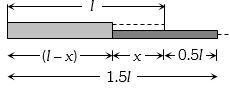
Then $4R = \rho \frac{{(l - x)}}{A} + \rho \frac{{(0.5l + x)}}{{A'}}$where $A' = \frac{x}{{(0.5l + x)}}A$
$4\rho \frac{l}{A} = \rho \frac{{l - x}}{A} + \rho \frac{{{{(0.5l + x)}^2}}}{{xA}}$
or $4l = l - x + \frac{1}{4}\frac{{{l^2}}}{x} + \frac{{{x^2}}}{x} + \frac{{lx}}{x}$ or $\frac{x}{l} = \frac{1}{8}$

Download our appand get started for free
Experience the future of education. Simply download our apps or reach out to us for more information. Let's shape the future of learning together!No signup needed.*
Similar Questions
- 1The resistance of a wire is$10\,\Omega $. Its length is increased by $10\%$ by stretching. The new resistance will now be .......... $\Omega$View Solution
- 2A $3\,^oC$ rise in temperature is observed in a conductor by passing a certain current. When the current is doubled, the rise in temperature will be ............. $^oC$View Solution
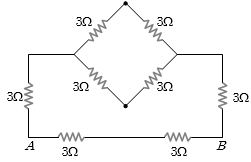
- 3Equivalent resistance between $A$ and $B$ will be ............ $ohm$View Solution
- 4At what temperature will the resistance of a copper wire become three times its value at $0\,^oC$ ................. $^oC$ (Temperature coefficient of resistance for copper = $4 × 10^{-3} \,per\, \,^oC$ )View Solution
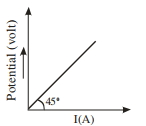
- 5The variation of applied potential and current flowing through a given wire is shown in figure. The length of wire is $31.4 \,cm$. The diameter of wire is measured as $2.4 \,cm$. The resistivity of the given wire is measured as $x \times 10^{-3} \,\Omega cm$. The value of $x$ is_______ [Take $\pi=3.14]$View Solution
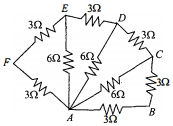
- 6Six resistors of $3 \;\Omega$ each are connected along the sides of a hexagon and three resistors of $6\; \Omega$ each are connected along $A C, A D$ and $A E$ as shown in the figure. The equivalent resistance between $A$ and $B$ is equal toView Solution
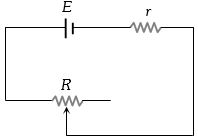
- 7A battery of $e.m.f.$ $E$ and internal resistance $r$ is connected to a variable resistor $R$ as shown here. Which one of the following is trueView Solution
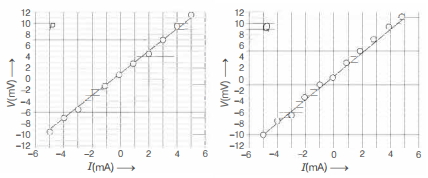
- 8Two students $P$ and $Q$ perform an experiment to verify Ohm's law for a conductor with resistance $R$. They use a current source and a voltmeter with least counts of $0.1 mA$ and $0.1 \,mV$, respectively. The plots of the variation of voltage drop $V$ across $R$ with current $I$ for both are shown below. The statement which is most likely to be correct?View Solution
- 9An electric bulb rated $50 \mathrm{~W}-200 \mathrm{~V}$ is connected across a $100 \mathrm{~V}$ supply. The power dissipation of the bulb is :View Solution
- 10In the shown circuit, what is the potential difference across $A$ and $B$ ......... $V$View Solution