At what temperature will the resistance of a copper wire become three times its value at $0\,^oC$ ................. $^oC$ (Temperature coefficient of resistance for copper = $4 × 10^{-3} \,per\, \,^oC$ )
Medium


Download our appand get started for free
Experience the future of education. Simply download our apps or reach out to us for more information. Let's shape the future of learning together!No signup needed.*
Similar Questions
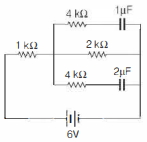
- 1What are the charges stored in the $1 \,\mu F$ and $2 \,\mu F$ capacitors in the circuit below, once the currents become steady?View Solution
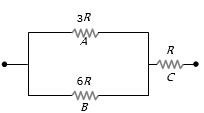
- 2The three resistances $A, B$ and $C$ have values $3R, 6R$ and $R$ respectively. When some potential difference is applied across the network, the thermal powers dissipated by $A, B$ and $C$ are in the ratioView Solution
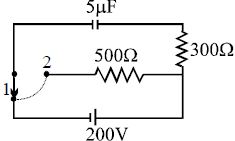
- 3A capacitor of capacitance $5\,\mu F$ is connected to a source of constant $emf$ of $200\,V$ for a long time, then the switch was shifted to contact $2$ from contact $1$ . The total amount of heat generated in the $500\,\Omega $ resistance, thereafter isView Solution
- 4Length of a hollow tube is $5\,m$, it’s outer diameter is $10\, cm$ and thickness of it’s wall is $5\, mm$. If resistivity of the material of the tube is $1.7 \times 10^{-8} \,\Omega m$ then resistance of tube will beView Solution
- 5When a resistor of $11 \,\Omega$ is connected in series with an electric cell, the current flowing in it is $0.5\, A$. Instead, when a resistor of $5 \,\Omega$ is connected to the same electric cell in series, the current increases by $0.4\, A$. The internal resistance of the cell is ................ $\Omega$View Solution
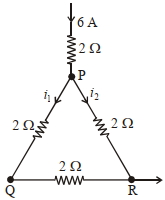
- 6A current of $6\, A$ enters one corner $P$ of an equilateral triangle $PQR$ having $3$ wires of resistance $2 \,\Omega$ each and leaves by the corner $R$. The currents $i_{1}$ in ampere is ........ .View Solution
- 7Space between two concentric conducting spheres of radii $a$ and $b (b > a)$ is filled with $a$ medium of resistivity $\rho $. The resistance between the two spheres will beView Solution
- 8Infinite number of cells having $emf$ and internal resistance $\left( {E,r} \right)$, $\left( {\frac{E}{n},\frac{r}{n}} \right)$, $\left( {\frac{E}{{{n^2}}},\frac{r}{{{n^2}}}} \right)$, $\left( {\frac{E}{{{n^3}}},\frac{r}{{{n^3}}}} \right)$..... are connected in series in same manner across an external resistance of $\frac{{nr}}{{n + 1}}$ . Current flowing through the external resistor isView Solution
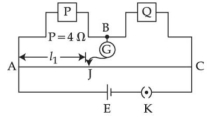
- 9Resistance are connected in a meter bridge circuit as shown in the figure. The balancing length $l_{1}$ is $40\,cm$. Now an unknown resistance $x$ is connected in series with $P$ and new balancing length is found to be $80\,cm$ measured from the same end. Then the value of $x$ will be $.......\Omega$View Solution
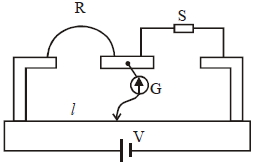
- 10In a meter bridge experiment $\mathrm{S}$ is a standard resistance. $\mathrm{R}$ is a resistance wire. It is found that balancing length is $l=25 \;\mathrm{cm} .$ If $\mathrm{R}$ is replaced by a wire of half length and half diameter that of $\mathrm{R}$ of same material, then the balancing distance $\left.l^{\prime} \text { (in } \mathrm{cm}\right)$ will now beView Solution