MCQ
In $P-N$ junction, the barrier potential offers resistance to
  • Free electrons in $N$ region and holes in $P$ region
  • B
    Free electrons in $P$ region and holes in $N$ region
  • C
    Only free electrons in $N$ region
  • D
    Only holes in $P$ region

Answer

Correct option: A.
Free electrons in $N$ region and holes in $P$ region
a
$P - N$ junction is the interface between $p$ type and $n$ type semiconductors. When both semiconductors are fused together opposite charge carriers are attracted and move across the junction for example : electrons get attracted towards the holes in p type semiconductor and holes get attracted towards the electrons of n type semiconductor during this movement immobile charge carriers left behind. The immobile charge carriers set up an imaginary potential across the junction and this potential is known as barrier potential. This barrier potential blocks the further movement of charge carriers across the junction hence offers the resistance to the charge carriers.

Hence, In $P - N$ junction, the barrier potential offers resistance to free electrons in $N$ region and holes in $P$ region.

Need a full question paper?

Generate a complete, print-ready paper with questions like this in minutes — across 16+ boards, with answer keys.
Start Generating Free

Similar questions

A parallel plate capacitor is charged by connecting it to a battery. The battery is disconnected and the plates of the capacitor are pulled apart to make the separation between the plates twice. Again the capacitor is connected to the battery (with same polarity) then
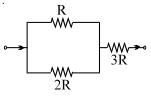
The ratio of powers dissipatted respectively in $R$ and $3R$, as shown is:
Unit of magnetic flux density (or magnetic induction) is
Two waves have their amplitudes in the ratio $1 : 9$. The maximum and minimum intensities when they interfere are in the ratio
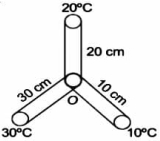
Three rods of same material, same area of crosssection but different lengths $10 \,cm , 20 \,cm$ and $30 \,cm$ are connected at a point as shown. What is temperature of junction $O$ is ......... $^{\circ} C$
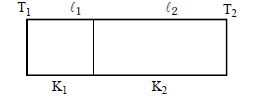
One end of a thermally insulated rod is kept at a temperature $T_1$ and the other at $T_2$. The rod is composed of two sections of lengths $l_1$ and $l_2$ and thermal conductivities $K_1$ and $K_2$ respectively. The temperature at the interface of the two sections is
For an object projected from ground with speed $u$ horizontal range is two times the maximum height attained by it. The horizontal range of object is ..........
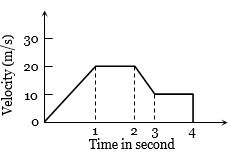
The variation of velocity of a particle with time moving along a straight line is illustrated in the following figure. The distance travelled by the particle in four seconds is.........$m$
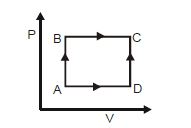
A shown in the figure, the amount of heat absorbed along the path $ABC$ is $90\,J$ and the amount of work done by the system is $30\,J$ . If the amount of work done along the path $ADC$ is $20\,J$ , the amount of heat absorbed will be  .... $J$
A cylinder with a movable piston contains air under a pressure $p_1$ and a soap bubble of radius $'r'$ . The pressure $p_2$ to which the air should be compressed by slowly pushing the piston into the cylinder for the soap bubble to reduce its size by half will be: (The surface tension is $\sigma $ , and the temperature $T$ is maintained constant)