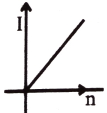
In previous problem, if the cell had been connected in parallel (instead of in series) which of the above graphs would have shown the relationship between total current $I$ and $n$?
Medium
Download our app for free and get started
$I=\frac{E}{\frac{r}{n}}=\frac{n E}{r}$

Download our appand get started for free
Experience the future of education. Simply download our apps or reach out to us for more information. Let's shape the future of learning together!No signup needed.*
Similar Questions
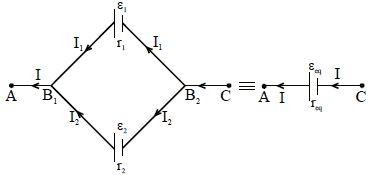
- 1Consider a parallel combination of the cellsshown in the figure.The potential difference in between $B_1$ and $B_2$ isView Solution
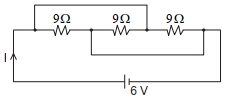
- 2The current $I$ flowing through the given circuit will be $.....A$.View Solution
- 3A $50\,V$ battery is connected across a $10\, ohm$ resistor. The current is $4.5\, amperes$. The internal resistance of the battery is ............. $ohm$View Solution
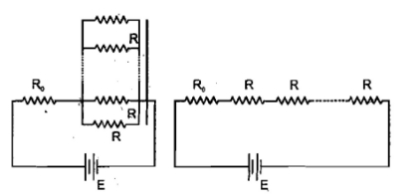
- 4In the circuit shown, $n$-identical resistors $R$ are connected in parallel $(n > 1)$ and the combination is connected in series to another resistor $R_0$. In the adjoining circuit $n$ resistors of resistance $R$ are all connected in series alongwith $R_0$. The batteries in both circuits are identical and net power dissipated in the $n$ resistors in both circuits is same. The ratio $R_0 / R$ isView Solution
- 5The length of a metallic wire is increased by $20 \%$ and its area of cross section is reduced by $4 \%$. The percentage change in resistance of the metallic wire is $.......$View Solution
- 6Potentiometer wire of length $1 \,m$ is connected in series with $490\,\Omega $ resistance and $2\,V$ battery. If $0.2\, mV/cm $ is the potential gradient, then resistance of the potentiometer wire is ................ $\Omega$View Solution
- 7A current of $5\, A$ passes through a copper conductor (resistivity $= 1.7\times10^{-8}\,\Omega \,m$) of radius of cross-section $5\, mm$. Find the mobility of the charges if their drift velocity is $1.1\times10^{-3}\, m/s$ ................ $m^2/Vs$View Solution
- 8A current of $2\, mA$ was passed through an unknown resistor which dissipated a power of $4.4\, W$. Dissipated power when an ideal power supply of $11\, V$ is connected across it isView Solution
- 9The heat produced by a $100\, watt$ heater in $2$ minute will be equal toView Solution
- 10A wire of resitance $R$ and length $L$ is cut into $5$ equal part. if these parts are joined parts are joined paralley, than result resistance will be:View Solution