A wire of resitance $R$ and length $L$ is cut into $5$ equal part. if these parts are joined parts are joined paralley, than result resistance will be:
JEE MAIN 2024, Diffcult
Download our app for free and get started
Resistance of each part $=\frac{R}{5}$
Total resistance $=\frac{1}{5} \times \frac{R}{5}=\frac{R}{25}$

Download our appand get started for free
Experience the future of education. Simply download our apps or reach out to us for more information. Let's shape the future of learning together!No signup needed.*
Similar Questions
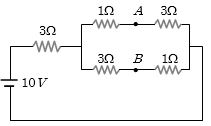
- 1A battery of $e.m.f.$ $10\, V$ is connected to resistance as shown in figure. The potential difference ${V_A} - {V_B}$ between the points $A$ and $B$ is .................... $V$View Solution
- 2A potentiometer wire of length $100\, cm$ has a resistance of $10\,\Omega $. It is connected in series with a resistance and a cell of $emf$ $2\, V$ and of negligible internal resistance. A source of $emf$ $10\,mV$ is balanced against a length of $40\, cm$ of the potentiometer wire. What is the value of external resistance ? .................. $\Omega$View Solution
- 3An electric kettle has two heating coils. When one of the coils is connected to an a.c. sotuce, the water in the kettle boils in $10$ minutes. When the other coil is used the w’ater boils in $40$ minutes. If both the coils are connected in parallel, the time taken by the same quantity of water to boil will be ...... $min$View Solution
- 4A resistor develops $500\, J$ of thermal energy in $20 \,s$ when a current of $1.5\, A$ is passed through it. If the current is increased from $1.5 \,A$ to $3\, A$ what will be the energy (in $J$) developed in $20\, s$.View Solution
- 5It is preferable to measure the $e.m.f.$ of a cell by potentiometer than by a voltmeter because of the following possible reasons.View Solution
$(i)$ In case of potentiometer, no current flows through the cell.
$(ii)$ The length of the potentiometer allows greater precision.
$(iii)$ Measurement by the potentiometer is quicker.
$(iv)$ The sensitivity of the galvanometer, when using a potentiometer is not relevant.
Which of these reasons are correct? - 6To get the maximum current from a parallel combination of $n$ identical cells each of internal resistance $r$ in an external resistance $R$, whenView Solution
- 7View SolutionTwo heating coils, one of fine wire and the other of thick wire of the same material and of the same length are connected in series and in parallel. Which of the following statement is correct
- 8View SolutionThe following four wires are made of the same material and are at the same temperature. Which one of them has highest electrical resistance
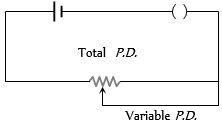
- 9View SolutionThe arrangement as shown in figure is called as
- 10Two electric bulbs marked $40\,W,$ $220\,V$ and $60\,W,\,\,220\,V$ when connected in series across same voltage supply of $220\,V,$ the effective power is $P_1$ and when connected in parallel, the effective power is $P_2.$ Then $\frac {P_1}{P_2}$ isView Solution