MCQ
In $R - L - C$ series circuit, the potential differences across each element is $20V$. Now the value of the resistance alone is doubled, then $P.D$. across $R, L$ and $C$ respectively.
  • $20V, 10V, 10V$
  • B
    $20V, 20V, 20V$
  • C
    $20V, 40V, 40V$
  • D
    $10V, 20V, 20V$

Answer

Correct option: A.
$20V, 10V, 10V$

Circuit is at resonance $(VL = VC)$
$\therefore$ circuit is purely resistance
Resistance is doubled, current in the circuit is half the initial value
$\therefore$ New current $\text{I′}=\frac{\text{I}}{2}$
$\therefore VR = 20V ($equal to applied voltage earlier$)$
$VL = 10V$
$VC = 10V$

Need a full question paper?

Generate a complete, print-ready paper with questions like this in minutes — across 16+ boards, with answer keys.

Start Generating Free

Similar questions

Consider a $\beta$ decay reaction

${}_1^3H \to {}_2^3He + {e^{ - 1}} + \bar v$

Atomic mass of ${}_1^3H$and ${}_2^3He$ are $3.016050\,u$ and $3.016030\,u$. Find the maximum possible energy of electron ....... $MeV$

When the number of turns in a coil is doubled without any change in the length of the coil, its self inductance becomes
If the frequency of the source $e.m.f.$ in an $ac$ circuit is $n,$ the power varies with a frequency :-
A transformer with efficiency 80% works at 4 kW and 100 V. If the secondary voltage is 200 V, then the primary and secondary currents are respectively
A body cools down from $65^\circ C$ to $60^\circ C$ in $5$ minutes. It will cool down from $60^\circ C$ to $55^\circ C$ in:
$100$ cells each of $e.m.f.$ $5\, V$ and internal resistance $1\, ohm$ are to be arranged so as to produce maximum current in a $25\, ohms$ resistance. Each row is to contain equal number of cells. The number of rows should be
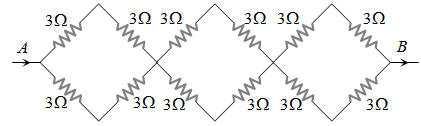
In the network of resistors shown in the adjoining figure, the equivalent resistance between A and B is
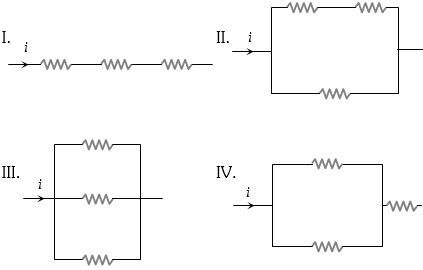
The three resistance of equal value are arranged in the different combinations shown below. Arrange them in increasing order of power dissipation.
An object if placed at a distance of $15\;cm$ from a convex lens of focal length $10\;cm$ on the other side of the lens, a convex mirror is placed at its foxus such that the image formed by combination coincides with the object itself. Find the focal length of concave mirror.
In Young's double slit experiment how many maximas can be obtained on a screen (including the central maximum) on both sides of the central fringe if $\lambda = 2000\,{Å}$ and $d = 7000\,{Å}$