MCQ
In R - L - C series circuit, the potential differences across each element is 20V. Now the value of the resistance alone is doubled, then P.D. across R, L and C respectively.
- A20V, 10V, 10V
- B20V, 20V, 20V
- C20V, 40V, 40V
- D10V, 20V, 20V
Explanation:
Circuit is at resonance (VL = VC)
$\therefore$ circuit is purely resistance
Resistance is doubled, current in the circuit is half the initial value
$\therefore$ New current $\text{I′}=\frac{\text{I}}{2}$
$\therefore$ VR = 20V (equal to applied voltage earlier)
VL = 10V
VC = 10V
Generate a complete, print-ready paper with questions like this in minutes — across 16+ boards, with answer keys.
A straight wire of length ( metre is carrying a current of 2A and the magnetic field due to it is measured at a point distant 1 cm from it. If the wire is to be bent into a circle and is to carry the same current as before, the ratio of the magnetic field at its centre to that obtained in the first case would be
|
(a) 50 : 1 |
(b) 1 : 50 |
(c) 100 : 1 |
(d) 1 : 100 |
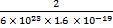
The Avogadro's number is 6  per gm mole and electronic charge is 1.6
  . The Faraday's number is
|
(a) |
(b) |
|
(c) |
(d) |
Total flux produced by a source of 1 cd is
|
(a) |
(b) 8 |
(c) 4 |
(d) |
A square of side ‘a’ has charge Q at its centre and charge ‘q’ at one of the corners. The work required to be done in moving the charge ‘q’ from the corner to the diagonally opposite corner is
|
(a) Zero |
(b) |
(c) |
(d) |
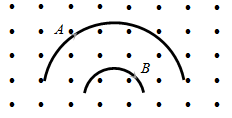
Two particles A and B of masses  and
and  respectively and having the same charge are moving in a plane. A uniform magnetic field exists perpendicular to this plane. The speeds of the particles are
  and
and  respectively, and the trajectories are as shown in the figure. Then
|
(a) |
(b) |
|
(c) |
(d) |
The line joining the pole and the centre of curvature of a mirror is called the:
A photo cell is receiving light from a source placed at a distance of 1 m. If the same source is to be placed at a distance of 2 m, then the ejected electron
|
(a) Moves with one-fourth energy as that of the initial energy |
|
(b) Moves with one-fourth of momentum as that of the initial momentum |
|
(c) Will be half in number |
|
(d) Will be one-fourth in number |
If two bulbs of wattage 25 and 30, each rated at 220 volts, are connected in series with a 440 volt supply, which bulb will fuse
|
(a) 25 W bulb |
(b) 30 W bulb |
(c) Neither of them |
(d) Both of them |