Question

In Rutherford scattering experiment, what will be the correct angle for α scattering for an impact parameter b = 0

(a) 90°

(b) 270°

(c) 0°

(d) 180°

Answer

(d) 180°

Need a full question paper?

Generate a complete, print-ready paper with questions like this in minutes — across 16+ boards, with answer keys.

Start Generating Free

Similar questions

Through a semiconductor, an electric current is due to drift of

(a) Free electrons

(b) Free electrons and holes

(c) Positive and negative ions

(d) Protons

The length of the optical path of two media in contact of length  and  of refractive indices   and  respectively, is

(a)  

(b)  

(c)     

(d)  

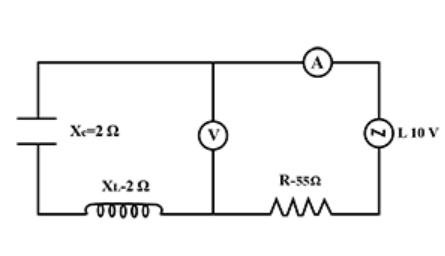
In the given figure as shown, the reading of the ammeter in ampere is.
Image
In Bohr model of hydrogen atom, let P.E. represents potential energy and T.E. represents the total energy. In going to a higher level:

Assertion  :   The tyres of aircraft's are slightly conducting.

Reason      : If a conductor is connected to ground, the extra charge induced on conductor will flow to ground.

(a) If both assertion and reason are true and the reason is the correct explanation of the assertion.

(b) If both assertion and reason are true but reason is not the correct explanation of the assertion.

(c) If assertion is true but reason is false.

(d) If the assertion and reason both are false.

A charged particle goes undeflected in a region containing an electric and a magnetic field. It is possible that
  1. $\overrightarrow{\text{E}}||\overrightarrow{\text{B}},\ \overrightarrow{\text{v}}||\overrightarrow{\text{E}}$
  2. $\overrightarrow{\text{E}}$ is not parallel to $\overrightarrow{\text{B}}$
  3. $\overrightarrow{\text{v}}||\overrightarrow{\text{B}}$ but $\overrightarrow{\text{E}}$ is not parallel to $\overrightarrow{\text{B}}$
  4. $\overrightarrow{\text{E}}||\overrightarrow{\text{B}}$ but $\overrightarrow{\text{v}}$ is not parallel to $\overrightarrow{\text{E}}$
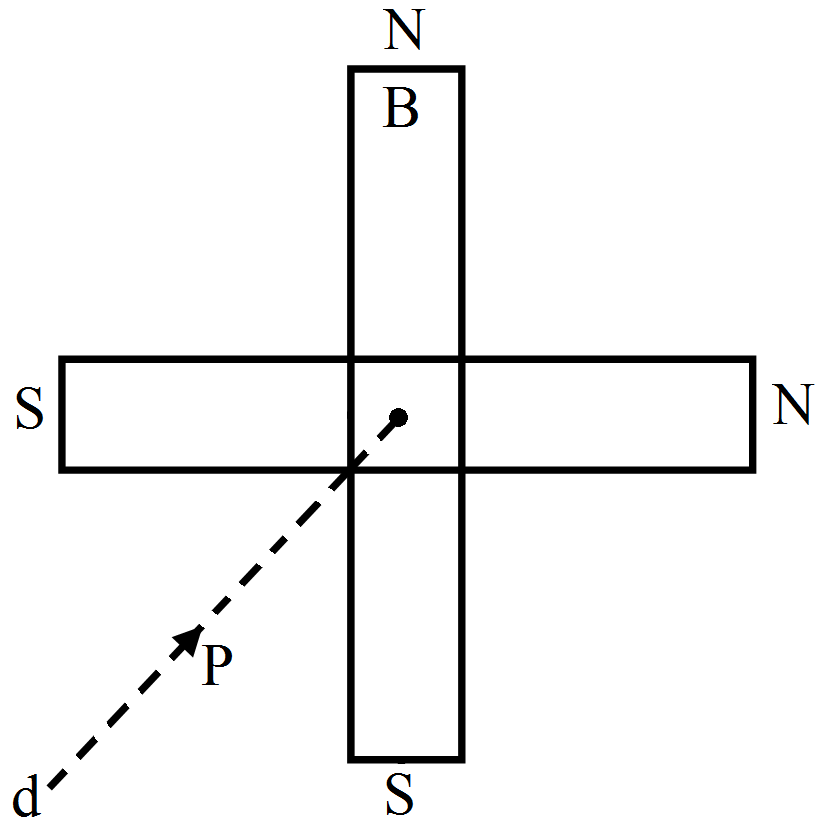
Two short magnets of equal dipole moments M are fastened perpendicularly at their centre (figure). The magnitude of the magnetic field at a distance d from the centre on the bisector of the right angle is:

  1. $\frac{\mu_0}{4\pi}\frac{\text{m}}{\text{d}^3}$

  2. $\frac{\mu_0}{4\pi}\frac{\sqrt{2}\text{M}}{\text{d}^3}$

  3. $\frac{\mu_0}{4\pi}\frac{\sqrt[2]{2}\text{M}}{\text{d}^3}$

  4. $\frac{\mu_0}{4\pi}\frac{2\text{M}}{\text{d}^3}$

In a semiconductor

(a) There are no free electrons at any temperature

(b) The number of free electrons is more than that in a conductor

(c) There are no free electrons at 0 K

(d) None of these

A proton enters in a straight line in a uniform magnetic field along the field direction. How will its path and velocity change?
If two soap bubbles of different radii are connected by a tube:
  1. Air flows from bigger bubble to the smaller bubble till the sizes become equal.
  2. Air flows from bigger bubble to the smaller bubble till the sizes are interchanged.
  3. Air flows from the smaller bubble to the bigger.
  4. There lis no flow of air.