MCQ
In Rutherford scattering experiment, what will be the correct angle for $\alpha $ scattering for an impact parameter $b = 0$.....$^o$
  • A
    ${90}$
  • B
    ${270}$
  • C
    ${0}$
  • ${180}$

Answer

Correct option: D.
${180}$
d
Impact parameter $b \propto \cot \frac{\theta }{2}$
Here $b = 0,$ hence $\theta = {180^o}$

Need a full question paper?

Generate a complete, print-ready paper with questions like this in minutes — across 16+ boards, with answer keys.

Start Generating Free

Similar questions

A rigid body is rotating with variable angular velocity $(a - bt)$ at any instant of time $ t.$ The total angle subtended by it before coming to rest will be ($a$ and $b$ are constants)
Match the pairs
Capacitor Capacitance
$(A)$ Cylindrical capacitor $(i)$ ${4\pi { \in _0}R}$
$(B)$ Spherical capacitor $(ii)$ $\frac{{KA{ \in _0}}}{d}$
$(C)$ Parallel plate capacitor having dielectric between its plates $(iii)$ $\frac{{2\pi{ \in _0}\ell }}{{ln\left( {{r_2}/{r_1}} \right)}}$
$(D)$ Isolated spherical conductor $(iv)$ $\frac{{4\pi { \in _0}{r_1}{r_2}}}{{{r_2} - {r_1}}}$
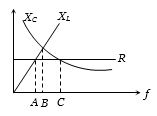
The figure shows variation of $R, X_L$ and $X_C$ with frequency f in a series $L, \,C, \,R $ circuit. Then for what frequency point, the circuit is inductive
Which of the following are true?

$A.$ Speed of light in vacuum is dependent on the direction of propagation.

$B.$ Speed of light in a medium in independent of the wavelength of light.

$C.$ The speed of light is independent of the motion of the source.

$D.$ The speed of light in a medium is independent of intensity.

Choose the correct answer from the option given below :
Power factor of an $L-R$ series circuit is $0.6$ and that of a $C-R$ series circuit is $0.5$. If the element ($L, C,$ and $R$) of the two circuits are joined in series the power factor of this circuit is found to be $1.$ The ratio of the resistance in the $L-R$ circuit to the resistance in the $C-R$ circuit is
The height $y$ and the distance $x$ along the horizontal plane of a projectile on a certain planet (with no surrounding atmosphere) are given by $y = (8t - 5{t^2})$ meter and $x = 6t\, meter$, where $t$ is in second. The velocity with which the projectile is projected is ......... $m/sec$.
The electrostatic potential inside a charged spherical ball is given by : $V = b -ar^2$, where  $r$ is the distance from the centre ; $a$ and $b$ are constants. Then, the charge density inside the ball is :
The ends $\mathrm{Q}$ and $\mathrm{R}$ of two thin wires, $\mathrm{PQ}$ and $RS$, are soldered (joined) togetker. Initially each of the wires has a length of $1 \mathrm{~m}$ at $10^{\circ} \mathrm{C}$. Now the end $\mathrm{P}$ is maintained at $10^{\circ} \mathrm{C}$, while the end $\mathrm{S}$ is heated and maintained at $400^{\circ} \mathrm{C}$. The system is thermally insulated from its surroundings. If the thermal conductivity of wire $\mathrm{PQ}$ is twice that of the wire $RS$ and the coefficient of linear thermal expansion of $P Q$ is $1.2 \times 10^{-5} \mathrm{~K}^{-1}$, the change in length of the wire $\mathrm{PQ}$ is
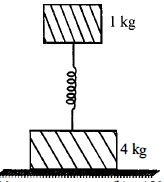
Two bodies of masses $1\, kg$ and $4\, kg$ are connected to a vertical spring, as shown in the figure. The smaller mass executes simple harmonic motion of angular frequency $25\, rad/s$, and amplitude $1.6\, cm$ while the bigger mass remains stationary on the ground. The maximum force exerted by the system on the floor is ..... $N$ ( take $g = 10\, ms^{-2}$)
Angular magnification of telescope if focal length of objective and eye lenses are $10\, cm$ and $10\, mm$ respectively and tube length is $11\, cm$