The ends $\mathrm{Q}$ and $\mathrm{R}$ of two thin wires, $\mathrm{PQ}$ and $RS$, are soldered (joined) togetker. Initially each of the wires has a length of $1 \mathrm{~m}$ at $10^{\circ} \mathrm{C}$. Now the end $\mathrm{P}$ is maintained at $10^{\circ} \mathrm{C}$, while the end $\mathrm{S}$ is heated and maintained at $400^{\circ} \mathrm{C}$. The system is thermally insulated from its surroundings. If the thermal conductivity of wire $\mathrm{PQ}$ is twice that of the wire $RS$ and the coefficient of linear thermal expansion of $P Q$ is $1.2 \times 10^{-5} \mathrm{~K}^{-1}$, the change in length of the wire $\mathrm{PQ}$ is
IIT 2016, Medium
Download our app for free and get started
Let the temperature of the junction be $T.$
$\therefore \text { rate of heat transfer }=\frac{d Q}{d t}=\frac{2 K A(T-10)}{L}=\frac{K A(400-T)}{L}$
$\Rightarrow 2(T-10)=400-T$
$\text { or, } T =140^{\circ} C$
Now, for the wire $P Q$, let us imagine a small length $\Delta x$ at a distance $x$ from the junction.
$\therefore \frac{\Delta T }{\Delta x }=\frac{140-10}{1}=130$
So, temperature at distance $x :$
$T=10+130 x$
or, $T -10=130 x$
Increase in length of the small element $\Delta x$ is expressed as:
$\frac{d y}{d x}=\alpha \Delta T =\alpha( T -10)$
$\text { or, } \frac{ dy }{ dx }=\alpha \times 130 x$
Integrating both sides, we get:
$\int_0^{\Delta L } dy =13 \circ \alpha \int_0^{ L } xdx$
$\because L =1 m \text { (Given) }$
$\text { or, } \Delta L =\frac{13 \circ ax ^2}{2}=\frac{130 \times 1.2 \times 10^{-5} \times 1}{0.78} m=0.78 \ mm$

Download our appand get started for free
Experience the future of education. Simply download our apps or reach out to us for more information. Let's shape the future of learning together!No signup needed.*
Similar Questions
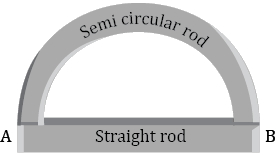
- 1Two rods (one semi-circular and other straight) of same material and of same cross-sectional area are joined as shown in the figure. The points $A$ and $B$ are maintained at different temperature. The ratio of the heat transferred through a cross-section of a semi-circular rod to the heat transferred through a cross section of the straight rod in a given time isView Solution
- 2View SolutionIf a black body is heated at a high temperature, it seems to be
- 3View SolutionThe quantity of heat which crosses unit area of a metal plate during conduction depends upon
- 4A liquid cools from $50^oC$ to $45^oC$ in 5 minutes and from $45 ^o C$ to $41.5 ^o C$ in the next $5$ minutes. The temperature of the surrounding is ...... $^oC$View Solution
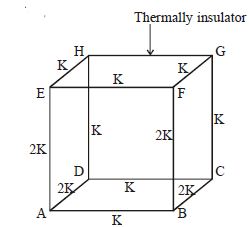
- 5Find effective thermal resistance between $A$ & $B$ of cube made up of $12$ rods of same dimensions and shown given thermal conductivity. [ $l =$ length of rod, $a =$ cross section area of rod]View Solution
- 6Wires $A$ and $B$ have identical lengths and have circular cross-sections. The radius of $A$ is twice the radius of $B$ $i.e.$ ${r_A} = 2{r_B}$. For a given temperature difference between the two ends, both wires conduct heat at the same rate. The relation between the thermal conductivities is given byView Solution
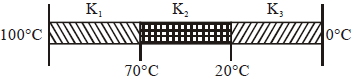
- 7Three rods of identical cross-section and lengths are made of three different materials of thermal conductivity $K _{1}, K _{2},$ and $K _{3}$, respectively. They are joined together at their ends to make a long rod (see figure). One end of the long rod is maintained at $100^{\circ} C$ and the ther at $0^{\circ} C$ (see figure). If the joints of the rod are at $70^{\circ} C$ and $20^{\circ} C$ in steady state and there is no loss of energy from the surface of the rod, the correct relationship between $K _{1}, K _{2}$ and $K _{3}$ isView Solution
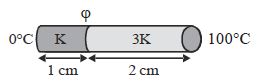
- 8Two bars of thermal conductivities $K$ and $3K$ and lengths $1\,\, cm$ and $2\,\, cm$ respectively have equal cross-sectional area, they are joined lengths wise as shown in the figure. If the temperature at the ends of this composite bar is $0\,^oC$ and $100\,^oC$ respectively (see figure), then the temperature $\varphi $ of the interface is......... $^oC$View Solution
- 9Two spherical bodies $\mathrm{A}$ (radius $6 \mathrm{~cm}$ ) and $\mathrm{B}$ (radius $18 \mathrm{~cm}$ ) are at temperature $\mathrm{T}_1$ and $\mathrm{T}_2$, respectively. The maximum intensity in the emission spectrum of $\mathrm{A}$ is at $500 \mathrm{~nm}$ and in that of $\mathrm{B}$ is at $1500 \mathrm{~nm}$. Considering them to be black bodies, what will be the ratio of the rate of total energy radiated by $A$ to that of $B$ ?View Solution
- 10When $p$ calories of heat is given to a body, it absorbs $q$ calories; then the absorbtion power of body will beView Solution