MCQ
In Searle's method for finding conductivity of metals, the temperature gradient along the bar
  • A
    Is greater nearer the hot end
  • B
    Is greater nearer to the cold end
  • Is the same at all points along the bar
  • D
    Increases as we go from hot end to cold end
Answer

Correct option: C.
Is the same at all points along the bar
(c)

Need a full question paper?

Generate a complete, print-ready paper with questions like this in minutes — across 16+ boards, with answer keys.

Start Generating Free

Similar questions

The kinetic energy of a particle executing $\text{S.H.M.}$ is $16 J$ when it is at its mean position. If the mass of the particle is $0.32 kg$, then what is the maximum velocity of the particle
A weight lifter lifts $300 \mathrm{~kg}$ from the ground to a height of 2 meter in 3 second. The average power generated by him is
On investigation of light from three different stars $A, B$ and $C$, it was found that in the spectrum of $A$ the intensity of red colour is maximum, in $B$ the intensity of blue colour is maximum and in $C$ the intensity of yellow colour is maximum. From these observations it can be concluded that
The angular velocity of the earth with which it has to rotate so that acceleration due to gravity on $60$ latitude becomes zero is (Radius of earth $=6400 \mathrm{~km}$. At the poles $g=10 \mathrm{~ms}^{-2}$ )
Least distance of distinct vision is $25 \mathrm{~cm}$. Magnifying power of simple microscope of focal length $5 \mathrm{~cm}$ is
An electric heater of resistance $6 ohm$ is run for 10 minutes on a 120 volt line. The energy liberated in this period of time is
Two bodies are projected with the same velocity. If one is projected at an angle of $30^{\circ}$ and the other at an angle of $60^{\circ}$ to the horizontal, the ratio of the maximum heights reached is
Weightlessness experienced while orbiting the earth in space-ship, is the result of
$100 \mathrm{~mA}$ current gives a full scale deflection in a galvanometer of $2 \Omega$ resistance. The resistance connected with the galvanometer to convert it into a voltmeter to measure $5 \mathrm{~V}$ is
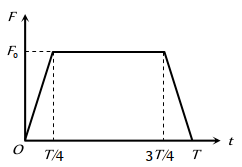
A particle of mass $m^V$ moving with a velocity $u$ makes an elastic one dimensional collision with a stationary particle of mass $m$ establishing a contact with it for extremely small time $T$. Their force of contact increases from zero to $F$ linearly in time $\frac{T}{4}$, remains constant for a further time $\frac{T}{2}$ and decreases linearly from $F$ to zero in further time $\frac{T}{4}$ as shown. The magnitude possessed by $F$ isImage