Question
In series combination of resistances:

Answer

Components connected in series are connected along a single path, so the same current flows through all of the components. The current through each of the components is the same, and the voltage across the circuit is the sum of the voltages across each component. In a series circuit, every device must function for the circuit to be complete. One bulb burning out in a series circuit breaks the circuit. A circuit composed solely of components connected in series is known as a series circuit.
The total resistance of resistors in series is equal to the sum of their individual resistances.
Hence, the Equivalent resistance is more than the individual resistances because a sum is taken of all the individual resistances.
That is, $R_{total​ }= R_{1 }​+ R_2​.$
The current is given as $I = I_1​ = I_2​.$
Below is the diagrammatic representation of $2$ resistors $R_1$​ and $R_{2​ }$ connected in series.

Need a full question paper?

Generate a complete, print-ready paper with questions like this in minutes — across 16+ boards, with answer keys.
Start Generating Free

Similar questions

The horizontal component of the earth's magnetic field is $0.22$ Gauss and total magnetic field is $0.4$ Gauss. The angle of dip. is
Indicate which one of the following system is digital (a) Pulse position modulation(b) Pulse code modulation(c) Pulse width modulation(d) Pulse amplitude modulation
   
   
Among the following properties describing diamagnetism identify  the property that is wrongly stated(a) Diamagnetic material do not have permanent magnetic moment(b) Diamagnetism is explained in terms of electromagnetic induction(c) Diamagnetic materials have a small positive susceptibility(d) The magnetic moment of individual electrons neutralize each other


A moving coil galvanometer has $150$ equal divisions. Its current sensitivity is $10$ divisions per milliampere and voltage sensitivity is $2$ divisions per millivolt. In order that each division reads $1$ volt, the resistance in ohms needed to be connected in series with the coil will be
An electric dipole placed in a non-uniform electric field can experience
In an oscillating system, a restoring force is a must. In an L-C circuit, the restoring force is provided by a/ an.
Two equal positive charges are kept at points A and B. The electric potential at the points between A and B (excluding these points) is studied while moving from A to B. The potential.
  1. Continuously increases.
  2. Continuously decreases.
  3. Increases then decreases.
  4. Decreases then increases.
The distance of closest approach of an alpha particle is $d$ when it moves with a speed $V$ towards a nucleus.
Another alpha particle is projected with higher energy such that the new distance of the closest approach is $d/2$ . What is the speed of projection of the alpha particle in this case?
What will be the nature of equipotential surfaces due to a point charge, situated at infinity?
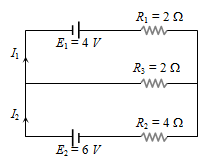
In the circuit shown below $\mathrm{E}_1=4.0 \mathrm{~V}, \mathrm{R}_1=2 \Omega, \mathrm{E}_2=6.0 \mathrm{~V}, \mathrm{R}_2=4 \Omega$ and $\mathrm{R}_3=2 \Omega$. The current $\mathrm{I}_1$ is