MCQ
In series combination of resistances:
- A$p.d.$ is same across each resistance.
- Btotal resistance is reduced.
- ✓current is same in each resistance.
- Dall above are true.
Components connected in series are connected along a single path, so the same current flows through all of the components. The current through each of the components is the same, and the voltage across the circuit is the sum of the voltages across each component. In a series circuit, every device must function for the circuit to be complete. One bulb burning out in a series circuit breaks the circuit. A circuit composed solely of components connected in series is known as a series circuit.
The total resistance of resistors in series is equal to the sum of their individual resistances. Hence, the Equivalent resistance is more than the individual resistances because a sum is taken of all the individual resistances. That is, $R_{\text {total }}=R_1+R_2$. The current is given as $I=I_1=I_2$.
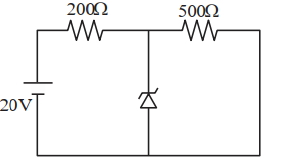
Below is the diagrammatic representation of $2$ resistors $R_1$ and $R_2$ connected in series.
Generate a complete, print-ready paper with questions like this in minutes — across 16+ boards, with answer keys.