In space of horizontal $EF$ ($E = (mg)/q$) exist as shown in figure and a mass $m$ attached at the end of a light rod. If mass $m$ is released from the position shown in figure find the angular velocity of the rod when it passes through the bottom most position

Advanced


Download our appand get started for free
Experience the future of education. Simply download our apps or reach out to us for more information. Let's shape the future of learning together!No signup needed.*
Similar Questions
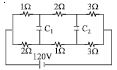
- 1In the circuit shown in figure $C_1 = C_2 = 2$ $\mu F$. Then charge stored inView Solution
- 2An electric dipole of moment $p$ is placed in the position of stable equilibrium in uniform electric field of intensity $E$. It is rotated through an angle $\theta $ from the initial position. The potential energy of electric dipole in the final position isView Solution
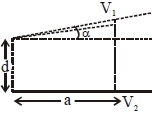
- 3A capacitor is made of two square plates each of side $a$ making a very small angle $\alpha$ between them, as shown in figure. The capacitance will be close toView Solution
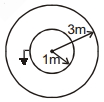
- 4Figure shows a solid conducting sphere of radius $1 m$, enclosed by a metallic shell of radius $3 \,m$ such that their centres coincide. If outer shell is given a charge of $6 \,\mu C$ and inner sphere is earthed, find magnitude charge on the surface of inner shell is ............. $\mu C$View Solution
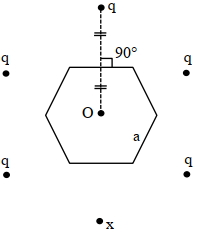
- 5Six charges are placed around a regular hexagon of side length a as shown in the figure. Five of them have charge $q$, and the remaining one has charge $x$. The perpendicular from each charge to the nearest hexagon side passes through the center $O$ of the hexagon and is bisected by the side.View Solution
Which of the following statement($s$) is(are) correct in SI units?
$(A)$ When $x=q$, the magnitude of the electric field at $O$ is zero.
$(B)$ When $x=-q$, the magnitude of the electric field at $O$ is $\frac{q}{6 \pi \in_0 a^2}$.
$(C)$ When $x=2 q$, the potential at $O$ is $\frac{7 q}{4 \sqrt{3} \pi \in_0 a}$.
$(D)$ When $x=-3 q$, the potential at $O$ is $\frac{3 q}{4 \sqrt{3} \pi \in_0 a}$.
- 6The plates of a capacitor are charged to a potential difference of $320 \, volts$ and are then connected across a resistor. The potential difference across the capacitor decays exponentially with time. After $1 $ second the potential difference between the plates of the capacitor is $240 \, volts$, then after $2$ and $3$ seconds the potential difference between the plates will beView Solution
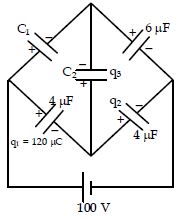
- 7In the circuit shown, $q_2$ and $q_3$ are respectively (Initially all capacitors are uncharged)View Solution
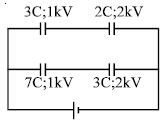
- 8The diagram shows four capacitors with capacitances and break down voltages as mentioned. What should be the maximum value of the external emf source such that no capacitor breaks down ? .......$kV$View Solution
- 9A capacitor when filled with a dielectric $K = 3$ has charge ${Q_0}$, voltage ${V_0}$ and field ${E_0}$. If the dielectric is replaced with another one having $K = 9$ the new values of charge, voltage and field will be respectivelyView Solution
- 10Charge of $2Q$ and $-Q$ are placed on two plates of a parallel plate capacitor. If capacitance of capacitor is $C$, potential difference between the plates isView Solution