An electric dipole of moment $p$ is placed in the position of stable equilibrium in uniform electric field of intensity $E$. It is rotated through an angle $\theta $ from the initial position. The potential energy of electric dipole in the final position is
AIPMT 1994, Medium


Download our appand get started for free
Experience the future of education. Simply download our apps or reach out to us for more information. Let's shape the future of learning together!No signup needed.*
Similar Questions
- 1An electric dipole moment $\vec p = (2.0\hat i + 3.0\hat j)$ $\mu C. $ $m$ is placed in a uniform electric field $\vec E = (3.0\hat i + 2.0\hat k)$ $×$$10^5$ $N$ $C^{-1}$.View Solution
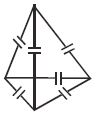
- 2If the capacitance of each capacitor in the tetrahedron shown is $C$ , then effective capacitance of the network across any two junctions is ......$C$View Solution
- 3A hollow metal sphere of radius $5\, cm$ is charged so that the potential on its surface is $10\, V$. The potential at the centre of the sphere isView Solution
- 4Assertion : If the distance between parallel plates of a capacitor is halved and dielectric constant is three times, then the capacitance becomes $6\,times$.View Solution
Reason : Capacity of the capacitor does not depend upon the nature of the material.
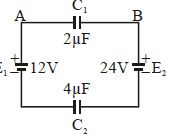
- 5Two capacitors $C_1$ and $C_2$ are connected in a cirucit as shown in figure. The potential difference $(V_A -V_B)$ is.....$V$View Solution
- 6View SolutionConsider the points lying on a straight line joining two fixed opposite charges. Between the charges there is
- 7View SolutionIf the distance between parallel plates of a capacitor is halved and dielectric constant is doubled then the capacitance will become
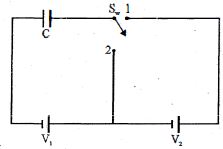
- 8The switch $S_w$ is shifted from position $1$ to position $2$ as shown in the figure. Heat generated in the circuit isView Solution
- 9Three capacitors of capacity ${C_1},\;{C_2}\;{C_3}$ are connected in series. Their total capacity will beView Solution
- 10The electric potential at the surface of an atomic nucleus $(Z = 50)$ of radius $9.0×{10^{ - 13}}\, cm$ isView Solution