MCQ
In stationary waves, antinodes are the points where there is
  • A
    Minimum displacement and minimum pressure change
  • B
    Minimum displacement and maximum pressure change
  • C
    Maximum displacement and maximum pressure change
  • Maximum displacement and minimum pressure change

Answer

Correct option: D.
Maximum displacement and minimum pressure change
d
Antinodes are the points on stationary wave with maximum displacement and maximum pressure change.Nodes are the point of zero displacement of particle and here pressure is also minimum.Antonodes are shown in the given figure.

Need a full question paper?

Generate a complete, print-ready paper with questions like this in minutes — across 16+ boards, with answer keys.

Start Generating Free

Similar questions

Law of equipartition of energy is used to:
A car is moving with a velocity of 30ms-1. On applying the brakes, the velocity decreases to 15ms-1 in 2s. The acceleration of the car is:
In which of the following process, convection does not take place primarily
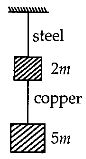
If the ratio of diameters, lengths and Young's modulus of steel and copper wires shown in the figure are $p, q$ and $s$ respectively, then the corresponding ratio of increase in their lengths would be
A particle covers half of its total distance with speed $v_1$ and the rest half distance with speed $v_2 .$ Its average speed during the complete journey is 
A satellite is orbiting the earth in a circular orbit of radius $r.$ Its
You lift a suitcase from the floor and keep it on a table. The work done by you on the suitcase does not depend on:
Two vibrating tuning forks produce progressive waves given by $y_1= 4 \sin (500 \, \pi t)$  and $y_2= 2 \sin (506 \, \pi t)$. These tuning forks are held near the ear of a person.  The person will hear
A steam boat goes across a lake and comes back $(a)$ On a quite day when the water is still and $(b)$ On a rough day when there is uniform air current so as to help the journey onward and to impede the journey back. If the speed of the launch on both days was same, in which case it will complete the journey in lesser time
A wheel initially at rest, is rotated with a uniform angular acceleration. The wheel rotates through an angle ${\theta _1}$ in first one second and through an additional angle ${\theta _2}$ in the next one second. The ratio $\frac{{{\theta _2}}}{{{\theta _1}}}$ is