MCQ
In stationary waves, distance between a node and its nearest antinode is $20 cm$. The phase difference between two particles having a separation of $60 cm$ will be
  • A
    Zero
  • B
    $\pi /2$
  • C
    $\pi$
  • $3 \pi /2$

Answer

Correct option: D.
$3 \pi /2$
d
(d) $\frac{\lambda }{4} = 20 \Rightarrow \lambda = \,80\,cm$,

also $\Delta \phi = \frac{\lambda }{{2\pi }}.\,\Delta x$ 

==> $\Delta \phi = $ $\frac{{60}}{{80}} \times 2\pi = \frac{{3\pi }}{2}$

Need a full question paper?

Generate a complete, print-ready paper with questions like this in minutes — across 16+ boards, with answer keys.
Start Generating Free

Similar questions

Ice formed over lakes has
A particle is executing simple harmonic motion $(SHM)$ of amplitude $A,$ along the $x-$ axis, about $x = 0.$ When its potential energy $(PE)$ equals kinetic energy $(KE),$ the position of the particle will be
A ball is projected from the ground at an angle of $45^{\circ}$ with the horizontal surface. It reaches a maximum height of $120 m$ and returns to the ground. Upon hitting the ground for the first time, it loses half of its kinetic energy. Immediately after the bounce, the velocity of the ball makes an angle of $30^{\circ}$ with the horizontal surface. The maximum height it reaches after the bounce, in metres, is. . . . .
The ratio of speed of sound in hydrogen gas to the speed of sound in oxygen gas at the same temperature is
A uniform rod of mass $m$ and length $l$ rotates in a horizontal plane with an angular velocity $\omega $ about a vertical axis passing through one end. The tension in the rod at a distance $x$ from the axis is
A particle executes linear simple harmonic motion with an amplitude of $2\, cm$. When the particle is at $1\, cm$ from the mean position the magnitude of its velocity is equal to that of its acceleration. Then its time period in seconds is
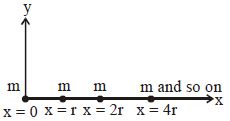
Consider an infinite distribution of point masses (each of mass $m$) placed on $x$ -axis  as shown in the diagram. What is the gravitational force acting on the point mass  placed at the origin ?
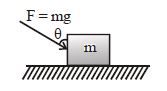
The force acting on the block pushes it, then pushing of the block will be possible along the surface if
A passeger sitting in a train facing towards the engine. The train is moving with a constant velocity. The passenger throws a ball upwards, then the ball will return:
Earth is flattened at the poles and bulges at the equator. This is due to the fact that: