MCQ
In stationary waves, distance between a node and its nearest antinode is $20 cm$. The phase difference between two particles having a separation of $60 cm$ will be
  • A
    Zero
  • B
    $\pi /2$
  • C
    $\pi$
  • $3 \pi /2$

Answer

Correct option: D.
$3 \pi /2$
d
(d) $\frac{\lambda }{4} = 20 \Rightarrow \lambda = \,80\,cm$,

also $\Delta \phi = \frac{\lambda }{{2\pi }}.\,\Delta x$ 

==> $\Delta \phi = $ $\frac{{60}}{{80}} \times 2\pi = \frac{{3\pi }}{2}$

Need a full question paper?

Generate a complete, print-ready paper with questions like this in minutes — across 16+ boards, with answer keys.
Start Generating Free

Similar questions

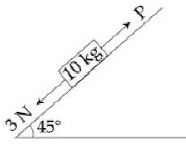
A block of mass $10\, kg$ is kept on a rough inclined plane as shown in the figure. A force of $3\, N$ is applied on the block. The coefficient of static friction between the plane and the block is $0.6$. What should be the minimum value of force $P$, such that the block does not move downward? (take $g = 10\, ms^{-2}$) ........ $N$
Three harmonic waves having equal frequency $\mathrm{v}$ and same intensity $\mathrm{I}_{0}$, have phase angles $0 , \frac{\pi}{4}$ and $-\frac{\pi}{4}$ respectively. When they are superimposed the intensity of the resultant wave is close to
A pendulum is suspended in a lift and its period of oscillation when the lift is stationary is  $T_0$. What must be the acceleration of the lift for the period of oscillation of the  pendulum to be $T_0/2$ ?
A hoop of radius $r$ and mass $m$ rotating with an angular velocity $\omega_0$ is placed on a rough horizontal surface. The initial velocity of the centre of the hoop is zero. What will be the velocity of the centre of the hoop when it ceases to slip?
The equation $\left(P+\frac{a}{V^2}\right)(V-b)=$ Constant. The units of a are
When a drop of oil is spread on a water surface, it displays beautiful colours in daylight because of:
  1. Disperson of light.
  2. Reflection of light.
  3. Polarization of light.
  4. Interference of light.
A uniform spherical planet (Radius $R$) has acceleration due to gravity at its surface $g.$ Points $P$ and $Q$ located inside and outside the planet have acceleration due to gravity $\frac{g}{4} .$ Maximum possible separation between $P$ and $Q$ is
A solid ball is completely immersed in a liquid. The coefficients of volume expansion of the ball and liquid are $3 × 10^{-6}$ and $8 × 10^{-6} per ^o C$ respectively. The percentage change in upthrust when the temperature is increased by $100 ^o C$ is ....... $\%$
A capillary tube is dipped in water and it is $20 \,cm$ outside water. The water rises upto $8 \,cm$. If the entire arrangement is put in freely falling elevator the length of water column in the capillary tube will be ........ $cm$
List-$I$ List-$II$
$(a)$ $MI$ of the rod (length ${L}$, Mass ${M}$, about an axis $\perp$ to the rod passing through the midpoint) $(i)\;\frac {8 {ML}^{2}}{3}$
$(b)$ MI of the rod (length $L$, Mass $2 M$, about an axis $\perp$ to the rod Passing through one its end) $(ii)\;\frac {{ML}^{2}}{3}$
$(c)$ MI of the rod (length $2 {L}$, Mass ${M}$, about an axis $\perp$ to the rod  Passing through its midpoint) $(iii)\;\frac {{ML}^{2}}{12}$
$(d)$ MI of the rod (length $2 {L}$, Mass $2 {M}$, about an axis $\perp$ to the rod  passing through one of its end) $(iv)\;\frac {2 {ML}^{2}}{3}$

 Choose the correct answer from the options given below