In steel, the Young's modulus and the strain at the breaking point are $2 \times {10^{11}}\,N{m^{ - 2}}$ and $0.15$ respectively. The stress at the breaking point for steel is therefore
Easy


Download our appand get started for free
Experience the future of education. Simply download our apps or reach out to us for more information. Let's shape the future of learning together!No signup needed.*
Similar Questions
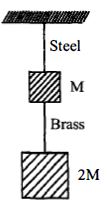
- 1If the ratio of lengths, radii and Young's moduli of steel and brass wires in the figure are $a, b$ and $c$ respectively, then the corresponding ratio of increase in their lengths isView Solution
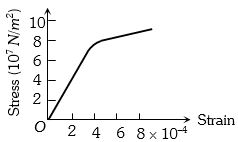
- 2Which one of the following is the Young’s modulus $($in $N/m^2)$ for the wire having the stress-strain curve shown in the figureView Solution
- 3A material has Poisson's ratio $0.50.$ If a uniform rod of it suffers a longitudinal strain of $2 \times {10^{ - 3}}$, then the percentage change in volume isView Solution
- 4A metal wire of length $L_1$ and area of cross section $A$ is attached to a rigid support. Another metal wire of length $L_2$ and of the same cross sectional area is attached to the free end of the first wire. A body of mass $M$ is then suspended from the free end of the second wire. If $Y_1$ and $Y_2$ are the Youngs moduli of the wires respectively, the effective force constant of the system of two wires is :View Solution
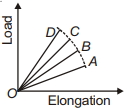
- 5View SolutionThe load versus elongation graph for four wires of same length and the same material is shown in figure. The thinnest wire is represented by line
- 6Given below are two statements: one is labelled as Assertion $A$ and the other is labelled as Reason $R$View Solution
Assertion $A$: Steel is used in the construction of buildings and bridges.
Reason $R:$ Steel is more elastic and its elastic limit is high.
In the light of above statements, choose the most appropriate answer from the options given below
- 7The Young's modulus of a steel wire of length $6\,m$ and cross-sectional area $3\,mm ^2$, is $2 \times 11^{11}\,N / m ^2$. The wire is suspended from its support on a given planet. A block of mass $4\,kg$ is attached to the free end of the wire. The acceleration due to gravity on the planet is $\frac{1}{4}$ of its value on the earth. The elongation of wire is (Take $g$ on the earth $=10$ $\left.m / s ^2\right):$View Solution
- 8A uniform metallic wire is elongated by $0.04\, m$ when subjected to a linear force $F$. The elongation, if its length and diameter is doubled and subjected to the same force will be ..... $cm .$View Solution
- 9When a load $W$ is hung from a wire of length $2\ L$ , it just breaks. Now this wire is completely melted and a new wire of length $L$ is formed. If the load $W$ is hung from this new wireView Solution
- 10Copper of fixed volume $V$ is drawn into wire of length $l$. When this wire is subjected to a constant force $F$, the extension produced in the wire is $\Delta l$. Which of the following graphs is a straight line?View Solution