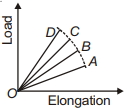
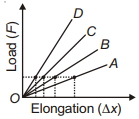
The load versus elongation graph for four wires of same length and the same material is shown in figure. The thinnest wire is represented by line
Medium


Download our appand get started for free
Experience the future of education. Simply download our apps or reach out to us for more information. Let's shape the future of learning together!No signup needed.*
Similar Questions
- 1A wire fixed at the upper end stretches by length $l$ by applying a force $F$. The work done in stretching isView Solution
- 2In steel, the Young's modulus and the strain at the breaking point are $2 \times {10^{11}}\,N{m^{ - 2}}$ and $0.15$ respectively. The stress at the breaking point for steel is thereforeView Solution
- 3The work done per unit volume to stretch the length of area of cross-section $2 \,mm ^2$ by $2 \%$ will be ....... $MJ / m ^3$ $\left[Y=8 \times 10^{10} \,N / m ^2\right]$View Solution
- 4A cylindrical wire of radius $1\,\, mm$, length $1 m$, Young’s modulus $= 2 × 10^{11} N/m^2$, poisson’s ratio $\mu = \pi /10$ is stretched by a force of $100 N$. Its radius will becomeView Solution
- 5A steel wire is $1 \,m$ long and $1 \,mm ^2$ in area of cross$-$section. If it takes $200 \,N$ to stretch this wire by $1 \,mm$, how much force will be required to stretch a wire of the same material as well as diameter from its normal length of $10 \,m$ to a length of $1002 \,cm$ is $........ N$View Solution
- 6View SolutionDue to addition of impurities, the modulus of elasticity
- 7The upper end of a wire of radius $4\, mm$ and length $100\, cm$ is clamped and its other end is twisted through an angle of $60^o$. Then angle of shear is .......... $^o$View Solution
- 8Given below are two statements: one is labelled as Assertion $A$ and the other is labelled as Reason $R$View Solution
Assertion $A$: Steel is used in the construction of buildings and bridges.
Reason $R:$ Steel is more elastic and its elastic limit is high.
In the light of above statements, choose the most appropriate answer from the options given below
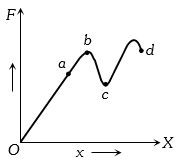
- 9The graph is drawn between the applied force $F$ and the strain $(x)$ for a thin uniform wire. The wire behaves as a liquid in the partView Solution
- 10The upper end of a wire $1\,m$ long and $4\,mm$ radius is clamped. The lower end is twisted by an angle of $30^o$. The angle of shear is ...... $^o$View Solution