MCQ
In $......$ strategy for saving the environment, things are used again and again :
  • Reuse
  • B
    Refuse
  • C
    Both $A$ and $B$
  • D
    None of the above

Answer

Correct option: A.
Reuse
In reuse strategy for saving the environment, things are used again and again. Many items found around the home can be used for different purposes. So before you throw those items away, think about how they can be reused.

Need a full question paper?

Generate a complete, print-ready paper with questions like this in minutes — across 16+ boards, with answer keys.
Start Generating Free

Similar questions

A student takes four test tubes marked $P, Q, R$ and $S$ of $25 mL$ capacity and fill $10 mL$ of distilled water in each. He dissolves one spoon full of four different salts in each as $-\ce{KCl}$ in $\mathrm{P}, \mathrm{NaCl}$ in $\mathrm{Q}, \mathrm{CaCl}_2$ in $R$ and $\mathrm{MgCl}_2$ in $S$ . He then adds about $2 mL$ of a sample of soap solution to each of the above test tubes. On shaking the contents of each of the test tubes, he is likely to observe a good amount of lather $($foam$)$ in the test tubes marked :
Absorption of light energy by chlorophy $\ce{ll}.$
Which of the following is correct order of atomic size?
Which of the following events does not occur in photosynthesis?
One of the following process does not lead to the formation of clones. This is :
Arabari forest of Bengal is dominated by:
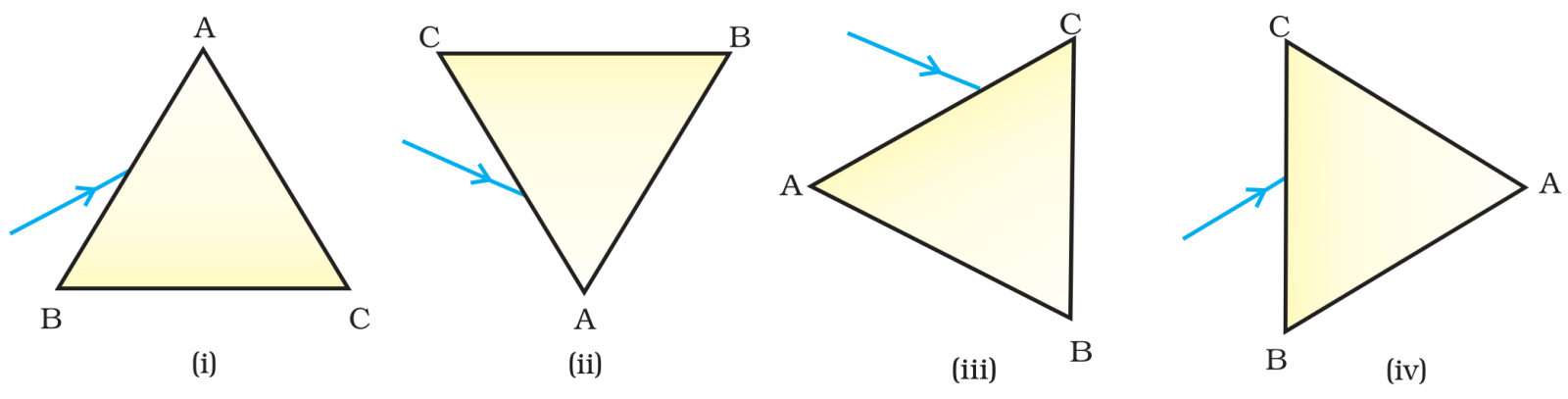
A prism ABC (with BC as base) is placed in different orientations. A narrow beam of white light is incident on the prism as shown in Figure. In which of the following cases, after dispersion, the third colour from the top corresponds to the colour of the sky?
Which of the following may be used to obtain an $F _2$ generation?
Sodium hydrogen carbonate when added to acetic acid evolves a gas. Which of the following statements are true about the gas evolved?
  1. It turns lime water milky.
  2. It extinguishes a burning splinter.
  3. It dissolves in a solution of sodium hydro.
  4. It has a pungent odour.
One of the following organic compounds cannot decolourise the red-brown colour bromine water. This compound is: