In suspended type moving coil galvanometer, quartz suspension is used because
Easy


Download our appand get started for free
Experience the future of education. Simply download our apps or reach out to us for more information. Let's shape the future of learning together!No signup needed.*
Similar Questions
- 1A uniform rod of length $L$ has a mass per unit length $\lambda$ and area of cross-section $A$. If the Young's modulus of the rod is $Y$. Then elongation in the rod due to its own weight is ...........View Solution
- 2A uniform rod of mass $m$, length $L$, area of cross-section $A$ and Young's modulus $Y$ hangs from the ceiling. Its elongation under its own weight will beView Solution
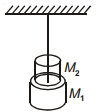
- 3The length of wire, when $M_1$ is hung from it, is $I_1$ and is $I_2$ with both $M_1$ and $M_2$ hanging. The natural length of wire is ........View Solution
- 4A wire of length $L$ is hanging from a fixed support. The length changes to $L _{1}$ and $L _{2}$ when masses $1 \,kg$ and $2 \,kg$ are suspended respectively from its free end. Then the value of $L$ is equal to ..................View Solution
- 5A $2 \,m$ long rod of radius $1 \,cm$ which is fixed from one end is given a twist of $0.8$ radians. The shear strain developed will beView Solution
- 6Young's modulus of rubber is ${10^4}\,N/{m^2}$ and area of cross-section is $2\,c{m^2}$. If force of $2 \times {10^5}$ dynes is applied along its length, then its initial length $l$ becomesView Solution
- 7The ratio of diameters of two wires of same material is $n : 1$. The length of wires are $4\, m$ each. On applying the same load, the increase in length of thin wire will beView Solution
- 8The work per unit volume to stretch the length by $1\%$ of a wire with cross sectional area of $1\,m{m^2}$ will be. $[Y = 9 \times {10^{11}}\,N/{m^2}]$View Solution
- 9A composite rod made up of two rods $AB$ and $BC$ are joined at $B$ . The rods are of equal length at room temperature and have equal masses. The coefficient of linear expansion a of $AB$ is more than that of $BC$. The composite rod is suspended horizontal by means of a thread at $B$. When the rod is heatedView Solution
- 10Two wires are made of the same material and have the same volume. However wire $1$ has crosssectional area $A$ and wire $2$ has cross-section area $3A$. If the length of wire $1$ increases by $\Delta x$ on applying force $F$, how much force is needed to stretch wire $2$ by the same amount?View Solution