Two wires are made of the same material and have the same volume. However wire $1$ has crosssectional area $A$ and wire $2$ has cross-section area $3A$. If the length of wire $1$ increases by $\Delta x$ on applying force $F$, how much force is needed to stretch wire $2$ by the same amount?
Medium


Download our appand get started for free
Experience the future of education. Simply download our apps or reach out to us for more information. Let's shape the future of learning together!No signup needed.*
Similar Questions
- 1$1\, m^3$ water is brought inside the lake upto $200$ metres depth from the surface of the lake. What will be change in the volume when the bulk modulus of elastically of water is $22000$ atmosphere? (density of water is $1\times10^3\, kg/m^3$ atmosphere pressure $= 10^5\, N/m^2$ and $g = 10\, m/s^2$)View Solution
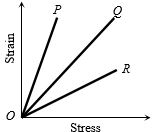
- 2The strain-stress curves of three wires of different materials are shown in the figure. $P, Q$ and $R$ are the elastic limits of the wires. The figure shows thatView Solution
- 3View SolutionStress vs strain curve for the elastic tissue of the aorta, the large tube (vessel) carrying blood from the heart, will be : [stress is proportional to square of the strain for the elastic tissue of the aorta]
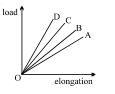
- 4View SolutionThe load versus strain graph for four wires of the same material is shown in the figure. The thickest wire is represented by the line
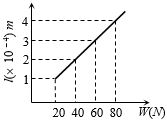
- 5The adjacent graph shows the extension $(\Delta l)$ of a wire of length $1m$ suspended from the top of a roof at one end with a load $W$ connected to the other end. If the cross sectional area of the wire is ${10^{ - 6}}{m^2},$ calculate the young’s modulus of the material of the wireView Solution
- 6A wire elongates by $l$ $mm$ when a load $W$ is hanged from it. If the wire goes over a pulley and two weights $W$ each are hung at the two ends, the elongation of the wire will be (in $mm$)View Solution
- 7The Young's modulus of a rubber string $8\, cm$ long and density $1.5\,kg/{m^3}$ is $5 \times {10^8}\,N/{m^2}$, is suspended on the ceiling in a room. The increase in length due to its own weight will beView Solution
- 8The following four wires of length $L$ and radius $r$ are made of the same material. Which of these will have the largest extension, when the same tension is applied?View Solution
- 9If Poission's ratio $\sigma $ is $ - \frac{1}{2}$ for a material, then the material isView Solution
- 10A force is applied to a steel wire ' $A$ ', rigidly clamped at one end. As a result elongation in the wire is $0.2\,mm$. If same force is applied to another steel wire ' $B$ ' of double the length and a diameter $2.4$ times that of the wire ' $A$ ', the elongation in the wire ' $B$ ' will be $............\times 10^{-2}\,mm$ (wires having uniform circular cross sections)View Solution