Question
In the above question, potential difference across the 40Ω resistance will be
|
(a) Zero |
(b) 80 V |
(c) 40 V |
(d) 120 V |
In the above question, potential difference across the 40Ω resistance will be
|
(a) Zero |
(b) 80 V |
(c) 40 V |
(d) 120 V |
(a) Zero
Generate a complete, print-ready paper with questions like this in minutes — across 16+ boards, with answer keys.
One metre length of wire carries a constant current. The wire is bent to form a circular loop. The magnetic field at the centre of this loop is B. The same is now bent to form a circular loop of smaller radius to have four turns in the loop. The magnetic field at the centre of this new loop is
|
(a) 4 B |
(b) 16 B |
(c) B/2 |
(d) B/4 |
A small coil C with N = 200 turns is mounted on one end of a balance beam and introduced between the poles of an electromagnet as shown in figure. The cross sectional area of coil is A= 1.0 cm2, length of arm OA of the balance beam is l = 30 cm. When there is no current in the coil the balance is in equilibrium. On passing a current I = 22 mA through the coil the equilibrium is restored by putting the additional counter weight of mass ∆m = 60 mg on the balance pan. Find the magnetic induction at the spot where coil is located.

|
(a) 0.4 T |
(b) 0.3 T |
(c) 0.2 T |
(d) 0.1 T |
Three resistances of magnitude 2, 3 and 5 ohm are connected in parallel to a battery of 10 volts and of negligible resistance. The potential difference across 3 Ω resistance will be
|
(a) 2 volts |
(b) 3 volts |
(c) 5 volts |
(d) 10 volts |
A metallic ring is attached with the wall of a room. When the north pole of a magnet is brought near to it, the induced current in the ring will be
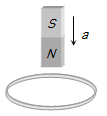
|
(a) First clockwise then anticlockwise |
(b) In clockwise direction |
|
(c) In anticlockwise direction |
(d) First anticlockwise then clockwise |
If an electron and a photon propagate in the form of waves having the same wavelength, it implies that they have the same
|
(a) Energy |
(b) Momentum |
(c) Velocity |
(d) Angular momentum |
If the strength of the magnetic field produced 10cm away from a infinitely long straight conductor is  , the value of the current flowing in the conductor will be
|
(a) 5 ampere |
(b) 10 ampere |
(c) 500 ampere |
(d) 1000 ampere |