MCQ
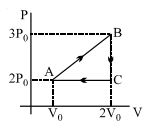
In the above thermodynamic process, the correct statement is
  • A
    Heat given in the complete cycle $ABCA$ is zero
  • B
    Work done in the complete cycle $ABCA$ is zero
  • Work done in the complete cycle $ABCA$ is $(1/2 P_0V_0)$
  • D
    None

Answer

Correct option: C.
Work done in the complete cycle $ABCA$ is $(1/2 P_0V_0)$
c

Need a full question paper?

Generate a complete, print-ready paper with questions like this in minutes — across 16+ boards, with answer keys.

Start Generating Free

Similar questions

A particle moves in the $xy$ plane with a constant acceleration $'g'$ in the negative $y$-direction. Its equation of motion is $y = ax-bx^2$, where $a$ and $b$ are constants. Which of the following are correct?
A body of mass $10\, kg$ is released from a tower of height $20\,m$ and body acquires a velocity of $10\,ms^{-1}$ after falling through the distance $20\,m$ . The work done by the push of the air on the body is:- ................. $\mathrm{J}$  (Take $g = 10\, m/s^2$ )
In a mechanical refrigerator, the low temperature coils are at a temperature of $-23°C$ and the compressed gas in the condenser has a temperature of $27°C.$ The theoretical coefficient of performance is
Two cars are moving in the same direction with a speed of $30 \,km / h$. They are separated from each other by $5 \,km$. Third car moving in the opposite direction meets the two cars after an interval of $4$ minutes. The speed of the third car is .......... $km / h$
Statement$-1:$ Two longitudinal waves given by equations $y _{1}( x , t )=2 a \sin (\omega t - kx )$ and $y _{2}( x , t )= a \sin (2 \omega t -2 kx )$ will have equal intensity.

Statement$-2:$ Intensity of waves of given frequency in same medium is proportional to square of amplitude only.
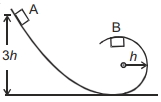
In the figure shown, a particle is released from the position $A$ on a smooth track. When the particle reaches at $B$, then normal reaction on it by the track is .........
The force required to keep a body in uniform circular motion is
Two spheres of the same material have radii $1\; m$ and $4\; m$ and temperatures $4000 \;K$ and $2000 \;K$ respectively. The ratio of the energy radiated per second by the first sphere to that by the second is
A $10 g$ bullet moving at $200 \,m / s$ stops after penetrating $5 \,cm$ of wooden plank. The average force exerted on the bullet will be .......... $N$
Two waves represented by $\text{y}=\text{a}\sin(\omega\text{t}-\text{kx})$ and $\text{y}=\text{a}\cos(\omega\text{t}-\text{kx})$ are superposed. The resultant wave will have an amplitude: