Answer

  1. 50º
    Solution:
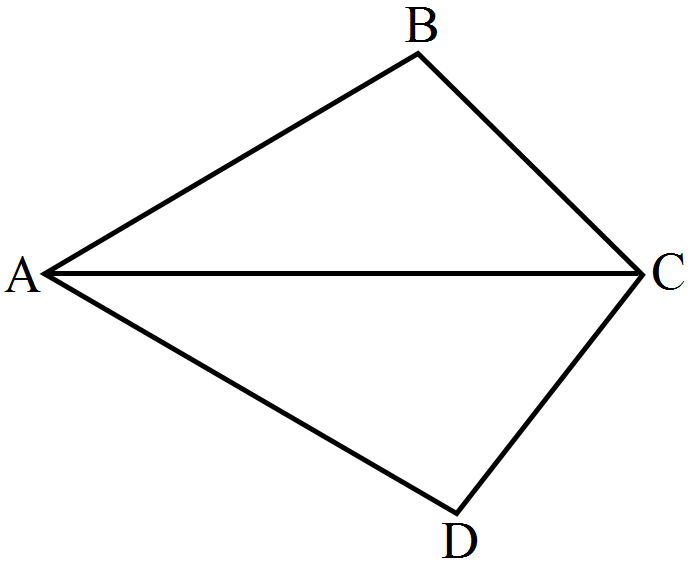
    In $\triangle\text{ABC}, \triangle\text{BAC} = 30^\circ$ and $\triangle\text{ABC}= 100^\circ$ (Given)
    $\angle\text{BAC} + \angle\text{ABC}+ \angle\text{BCA} = 180^\circ$
    $\angle\text{BCA}= 50^\circ$
    Also $\angle\text{ACD}= 50^\circ$ (Since, $\triangle\text{ABC}\cong\triangle\text{ADC}$).

Need a full question paper?

Generate a complete, print-ready paper with questions like this in minutes — across 16+ boards, with answer keys.

Start Generating Free

Similar questions

In triangles ABC and PQR three equality relation between some parts are as follows:
$\text{AB}=\text{QP},\angle\text{B}=\angle\text{P}$ and $\text {BC}=\text{PR}$
State which of the congruence conditions applies:
  1. SAS
  2. ASA
  3. SSS
  4. RHS
In a quadrilateral ABCD, $\angle\text{A}+\angle\text{C}$ is 2 times $\angle\text{B}+\angle\text{D}$ If $\angle\text{A}=140^\circ$ and $\angle\text{D}=60^\circ$ then $\angle\text{B}=$
  1. 60°
  2. 80°
  3. 120°
  4. None of these.
The figure formed by joining the mid-points of the adjacent sides of a square is a:
The height of a cone is 16 cm and its base radius is 12 cm. The curved surface area and total surface area are in the ratio
The ratio between the volume of a sphere and volume of a circumscribing right circular cylinder is:
Write the correct answer in the following:
If the perpendicular distance of a point P from the x-axis is 5 units and the foot of the perpendicular lies on the negative direction of x-axis, then the point P has:
In a cylindrical drum of radius 4.2m and height 3.5m, the number of full bags of wheat can be emptied if the space required for wheat in each bag is 2.1 cu. M, is:
Simplified value of $(25)^{\frac{1}{3}}\times5^{\frac{1}{3}}$ is:
  1. 25
  2. 3
  3. 1
  4. 5
Let l be the lower class limit of a class-interval in a frequency distribution and m be the mid point of the class. Then, the upper class limit of the class is:
  1. $\text{m}+\frac{\text{l+m}}{2}$
  2. $\text{l}+\frac{\text{m+l}}{2}$
  3. $2\text{m}-1$
  4. $\text{m}-2\text{l}$
A rational number lying between $\sqrt{2}$ and $\sqrt{3}$ is:
  1. $\frac{\big(\sqrt{2}+\sqrt{3}\big)}{2}$
  2. $\sqrt{6}$
  3. 1.6
  4. 1.9