Question
In the Auger process an atom makes a transition to a lower state without emitting a photon. The excess energy is transferred to an outer electron which may be ejected by the atom. (This is called an Auger electron). Assuming the nucleus to be massive, calculate the kinetic energy of an n = 4 Auger electron emitted by Chromium by absorbing the energy from a n = 2 to n = 1 transition.
Answer

As the nucleus is massive, recoil momentum of the atom may be neglected and the entire energy of the transition may be considered transferred to the Auger electron. As there is a single valence electron in Cr, the energy states may be thought of as given by the Bohr model.The energy of the nth state $\text{En}=-\text{Z}^2\text{R}\frac{1}{\text{n}^2}$ where R is the Rydberg constant and Z = 24.
The energy released in a transition form 2 to 1 is $\Delta\text{t}=\text{Z}^2\text{R}\Big(1-\frac{1}{4}\Big)=\frac{3}{4}\text{Z}^2\text{R}$.
The energy required to eject a n = 4 electron is $\text{E}_4=\text{Z}^2\text{R}\frac{1}{16}$.
Thus, the kinetic energy of the Auger electron is $\text{KE}=\text{Z}^2\text{R}\Big(\frac{3}{4}-\frac{1}{16}\Big)=\frac{1}{16}\text{Z}^2\text{R}$
$=\frac{11}{16}\times24\times24\times13.6\text{eV}=5385.6\text{eV}.$

Need a full question paper?

Generate a complete, print-ready paper with questions like this in minutes — across 16+ boards, with answer keys.

Start Generating Free

Similar questions

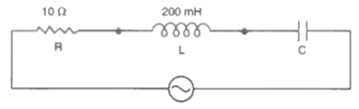
In the following circuit, calculate:
$i$. the capacitance of the capacitor, if the power factor of the circuit is unity,
$ii$. the $Q-$ factor of this circuit. What is the significance of the $Q-$ factor in ac circuit? Given the angular frequency of the ac source to be $100 \text{ rad/s}.$ Calculate the average power dissipated in the circuit.

Image
Add vectors $\overrightarrow{\text{A}},\overrightarrow{\text{B}}$ and $\overrightarrow{\text{C}}$ each having magnitude of 100 unit and inclined to the X-axis at angles 45°, 135° and 315° respectively.
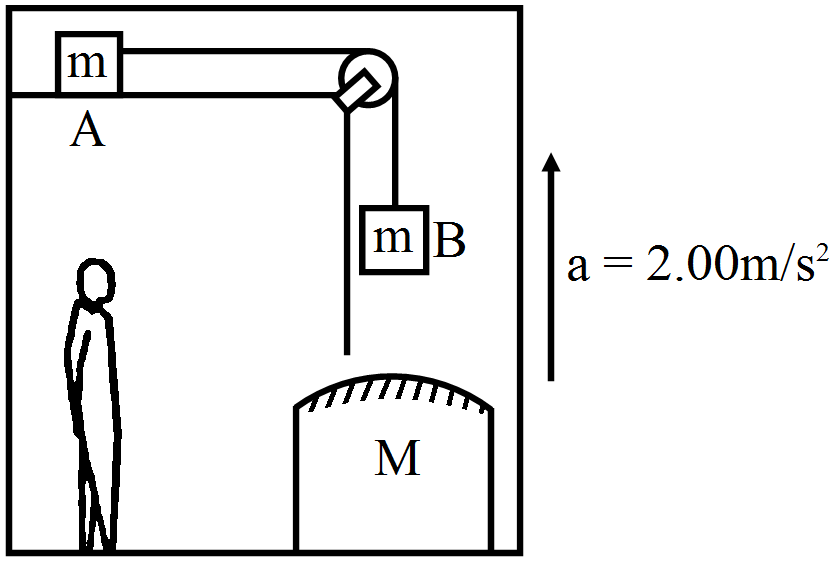
Consider the situation shown in figure. The elevator is going up with an acceleration of $2.00m/s^2$ and the focal length of the mirror is $12.0\ cm$. All the surfaces are smooth and the pulley is light. The mass$-$pulley system is released from rest $($with respect to the elevator$)$ at $t = 0$ when the distance of $B$ from the mirror is $42.0\ cm$. Find the distance between the image of the block $B$ and the mirror at $t = 0.200s$. Take $g = 10m/s^2.$
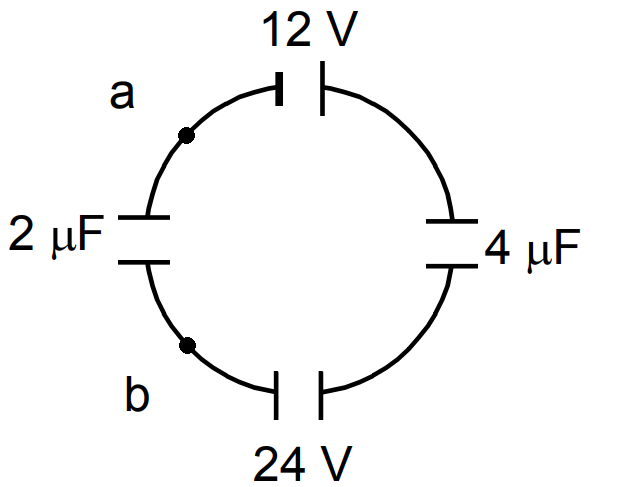
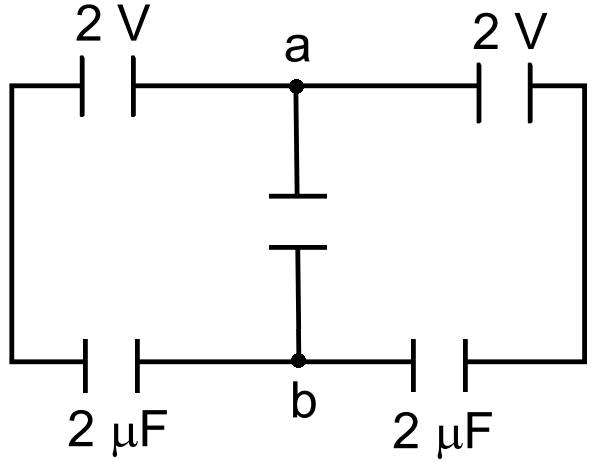
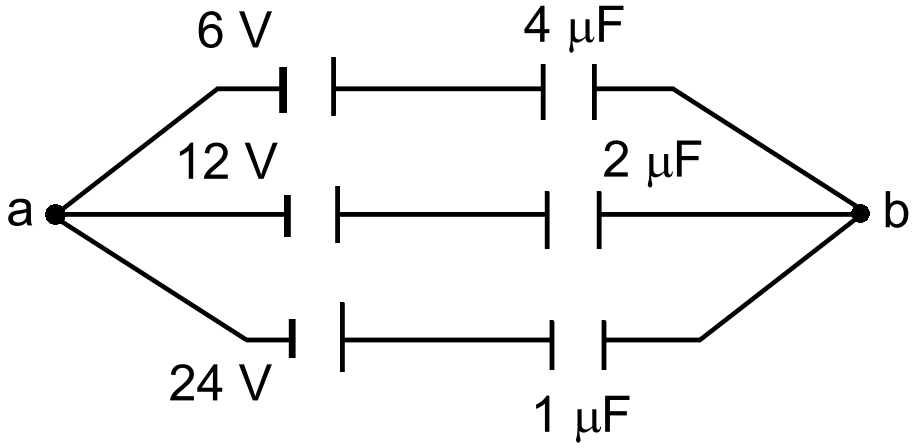
Find the potential difference $V_a - V_b$ between the points a and b shown in each part of the figure.


An eye can distinguish between two points of an object if they are separated by more than $0.22\ mm$ when the object is placed at $25\ cm$ from the eye. The object is now seen by a compound microscope having a $20D$ objective and $10D$ eyepiece separated by a distance of $20\ cm$. The final image is formed at $25\ cm$ from the eye. What is the minimum separation between two points of the object which can now be distinguished?
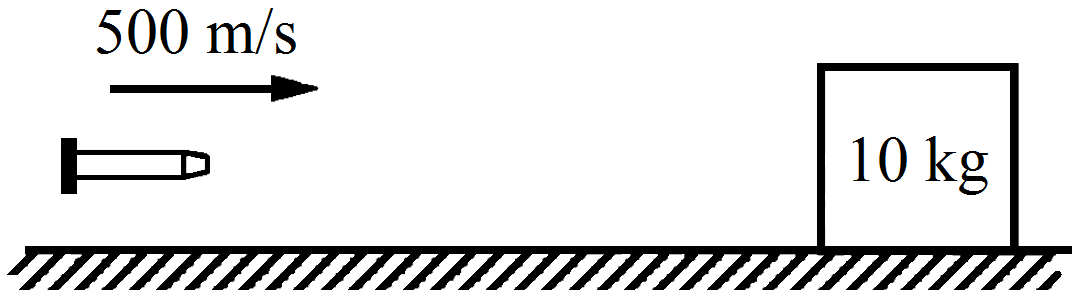
A bullet of mass $20g$ travelling horizontally with a speed of $500m/s$ passes through a wooden block of mass $10.0\ kg$ initially at rest on a level surface. The bullet emerges with a speed of $100m/s$ and the block slides $20\ cm$ on the surface before coming to rest. Find the friction coefficient between the block and the surface.
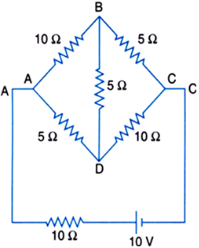
Determine the current in each branch of the network shown in Fig.:
The intensity of the sunlight reaching Earth is $1380Wm^{-2}.$ Assume this light to be a plane, monochromatic wave. Find the amplitudes of electric and magnetic fields in this wave.
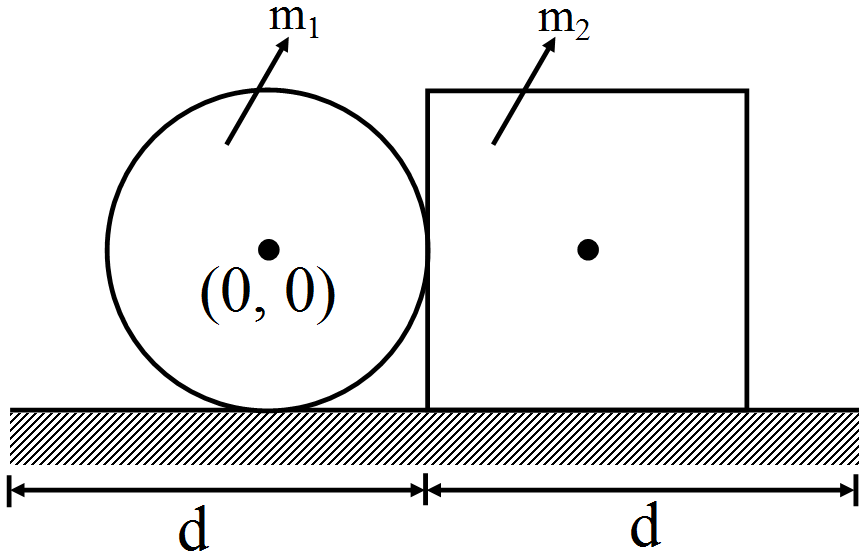
A square plate of edge d and a circular disc of diameter d are placed touching each other at the midpoint of an edge of the plate as shown in figure. Locate the centre of mass of the combination, assuming same mass per unit area for the two plates.
A pin of length $2.00\ cm$ is placed perpendicular to the principal axis of a converging lens. An inverted image of size $1.00\ cm$ is formed at a distance of $40.0\ cm$ from the pin. Find the focal length of the lens and its distance from the pin.