MCQ
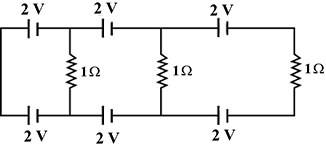
In the below circuit the current in each resistance is
  • A
    $1$ $A$ 
  • B
    $0.25$ $ A$
  • C
    $0.5$ $ A$
  • $0$ $ A$

Answer

Correct option: D.
$0$ $ A$
d
The potential difference in each loop is zero.

$\therefore $ No current will flow or current in each resistance is Zero.

Need a full question paper?

Generate a complete, print-ready paper with questions like this in minutes — across 16+ boards, with answer keys.
Start Generating Free

Similar questions

A particle of mass $m$ oscillates with simple harmonic motion between points ${x_1}$ and ${x_2}$, the equilibrium position being $O$. Its potential energy is plotted. It will be as given below in the graph
The ratio of momenta of an electron and an $\alpha - $particle which are accelerated from rest by a potential difference of $100 V$ is
Choose the correct statement
In Young's double slit experiment the two slits are $0.6 \; mm$ distance apart. Interference pattern is observed on a screen at a distance $80 \; cm$ from the slits. The first dark fringe is observed on the screen directly opposite to one of the slits. The wavelength of light will be $\dots \; nm .$
The potential gradient at which the dielectric of a condenser just gets punctured is called
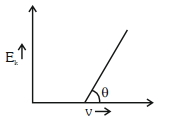
For the photoelectric effect, the maximum kinetic energy $\left(E_{\mathrm{k}}\right)$ of the photoelectrons is plotted against the frequency $(v)$ of the incident photons as shown in figure. The slope of the graph gives
The minimum force required to start pushing a body up a rough (frictional coefficient $\mu$) inclined plane is $F _{1}$ while the minimum force needed to prevent it from sliding down is $F _{2}$. If the inclined plane makes an angle $\theta$ from the horizontal such that $\tan \theta=2 \mu$, then the ratio $\frac{F_{1}}{F_{2}}$ is
Assertion : The image of a virtual object due to a plane mirror is real.

Reason : If the rays seem to be converging at a point behind a plane mirror, they are reflected and they actually meet in front of the mirror.

A double convex lens has power $P$ and same radii of curvature $R$ of both the surfaces. The radius of curvature of a surface of a plano-convex lens made of the same material with power $1.5P$ is ......$R$
A refrigerator consumes an average $35\, {W}$ power to operate between temperature $-10^{\circ} {C}$ to $25^{\circ} {C}$. If there is no loss of energy then how much average heat per second does it transfer? (in ${J} / {s}$)