MCQ
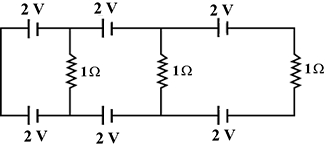
In the below circuit the current in each resistance is
  • A
    $1$ $A$ 
  • B
    $0.25$ $ A$
  • C
    $0.5$ $ A$
  • $0$ $ A$

Answer

Correct option: D.
$0$ $ A$
d
The potential difference in each loop is zero.

$\therefore $ No current will flow or current in each resistance is Zero.

Need a full question paper?

Generate a complete, print-ready paper with questions like this in minutes — across 16+ boards, with answer keys.

Start Generating Free

Similar questions

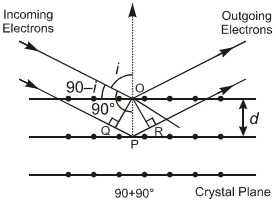
Wave property of electrons implies that they will show diffraction effects. Davisson and Germer demonstrated this by diffracting electrons from crystals. The law governing the diffraction from a crystal is obtained by requiring that electron waves reflected from the planes of atoms in a crystal interfere constructively (see figure).

Electrons accelerated by potential $V$ are diffracted from a crystal. If $d =1\; \mathring A$, and $i =30^{\circ}$. $V$ should be about ....... $V$

$\left( h =6.6 \times 10^{-34}\; J-s , m =9.1\times 10^{-31}\; kg , e =1.610^{-19} \;C \right)$
A nucleus ${n^X}^m$ emits one α and one β particles. The resulting nucleus is
 
The effective resistance of a parallel connection that consists of four wires of equal length, equal area of cross-section and same material is $0.25\, \Omega$. What will be the effective resistance if they are connected in series ? (In $\Omega$)
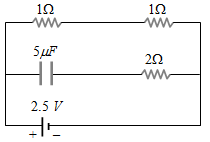
A capacitor of capacitance 5$\mu F$ is connected as shown in the figure. The internal resistance of the cell is 0.5 Ω. The amount of charge on the capacitor plate is
Two charges +4e and +e are at a distance x apart. At what distance, a charge q must be placed from charge +e so that it is in equilibrium
When photon of energy $4.25\, eV$ strike the surface of a metal $A$, the ejected photoelectrons have maximum kinetic energy $T_A\, eV$ and de-Brolie wavelength ${\lambda _A}$. The maximum kinetic energy of photoelectrons liberated from another metal $B$ by photon of energy $4.70  \ eV$ is ${T_B} = ({T_A} - 1.50)\;eV$. If the de-Broglie wavelength of these photoelectrons is ${\lambda _B} = 2{\lambda _A}$, then
E.C.E. of Cu and Ag are $7 \times 10^{-6}$ and $1.2 \times 10^{-6}$. A certain current deposits 14 gm of Cu. Amount of Ag deposited is
In $SI$, Henry is the unit of
A convex lens has 9 cm focal length and a concave lens has – 18 cm focal length. The focal length of the combination in contact will be
A 1mm thick paper of dielectric constant $4$ lies between the plates of a parallel-plate capacitor. It is charged to $100$ volt the intensity of electric field between the plates of the condenser will be: