Question
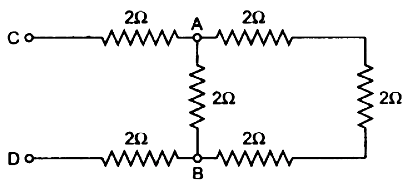
In the circuit shown below, calculate the equivalent resistance between the points (i) A and B, (ii) C and D.

Answer


(i) Between the points A and B : Three resistance 2 Ω, 2Ω, 2Ω are in series.
The equivalent resistance R' = 2 + 2 + 2 = 6 Ω
This is joined in parallel with a resistance 2Ω
The equivalent resistance $R=\frac{2 \times 6}{2+6}=\frac{12}{8}=15 . \Omega$
(ii) Between the points C and D:
The above combination of equivalent resistance 1.5 Ω is in series with two resistances 2Ω and 2Ω
Total effective resistance between the points C and D is R
= 1.5 + 2 + 2 = 5.5

Need a full question paper?

Generate a complete, print-ready paper with questions like this in minutes — across 16+ boards, with answer keys.
Start Generating Free

Similar questions

Two sets A and B of four bulbs each are glowing in two separate rooms. When one of the bulbs in set A is fused, the other three bulbs also cease to glow. But in set B, when one bulb fuses the other bulbs continue to glow. Explain the difference.
Describe a simple experiment to illustrate the phenomenon of resonance and explain it.
(i) Draw a clear labelled diagram of an electric bell.
(ii) Explain in brief, its working.
(iii) What material is used for the core of an electric bell? State the reason.
Why are the stringed instruments like guitar provided with a hollow sound box?
What is the equivalent resistance between the points $X$ and $Y$ for the given network?
What is meant by the ‘loudness’ of a sound? How is it related to the intensity?
(a) State the function of the following parts in D.C. motor :
(1) Insulated copper coil.
(2) Soft iron core.
(3) Split ring commutator,
(4) Carbon brushes.
(b) In which positions the deflecting couple acting on the coil is :
(1) Maximum.
(2) Minimum.
(c) How is the jerky motion of the coil turned into smooth circular motion?
(d) State three ways of making motor more powerful.
Trace a ray of light incident at 30° on a surface if travelling from air to glass. What is the angle of refraction in this case? (R.I. for glass = 3/2).
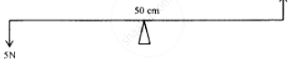
Two forces each of 5N act vertically upwards and downwards respectively on the two ends of a uniform metre rule which is placed at its mid-point as shown in the diagram. Determine the magnitude of the resultant moment of these forces about the midpoint.
Image
A house is provided with 15 bulbs of 40W, 5 bulbs of 100W, 5 fans of 80 W, and one heater of 1.0 kW. Each day bulbs are used for 4h, fans for lOh, and heater for 2h. The voltage of mains is 220 V. Calculate:
(i) Maximum power of the circuit in the house,
(ii) maximum current capacity of the main fuse in the house,
(iii) the electrical energy consumed in a week,
(iv) cost of electricity consumed at 1.25 Rs. per kWh.