Question
Why are the stringed instruments like guitar provided with a hollow sound box?

Answer

The sound box is constructed such that the column of the air inside it, has a natural frequency which is the same as that of the strings stretched on it, so that when the strings are made to vibrate, the air column inside the box is set into forced vibrations. Since the sound box has a large area, it sets a large volume of air into vibration, the frequency of which is same as that of the string. So, due to resonance a loud sound is produced.

Need a full question paper?

Generate a complete, print-ready paper with questions like this in minutes — across 16+ boards, with answer keys.
Start Generating Free

Similar questions

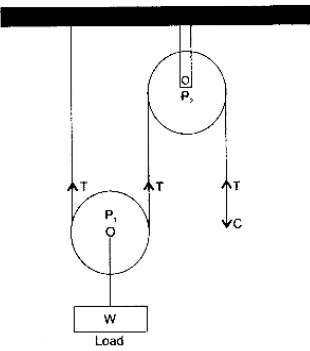
The alongside figure shows the combination of a movable pulley $P_1$ with a fixed pulley $P_2$ used for lifting up a load $W$
Image
(i) State the function of the fixed pulley $P_2.​​​​​​​$​​​​​​​
(ii) If the free end of the string moves through a distance x, find the distance by which the load W is raised.
(iii) Calculate the force to be applied at C to just raise the load $W = 20$ kgf, neglecting the weight of the pulley $P_1​​​​​​​$​​​​​​​ and friction.
Water in a pond appears to be only three–quarters of its actual depth. What property of light is responsible for this observation? Illustrate your answer with the help of a ray diagram. How is the refractive index of water calculated from its real and apparent depth?
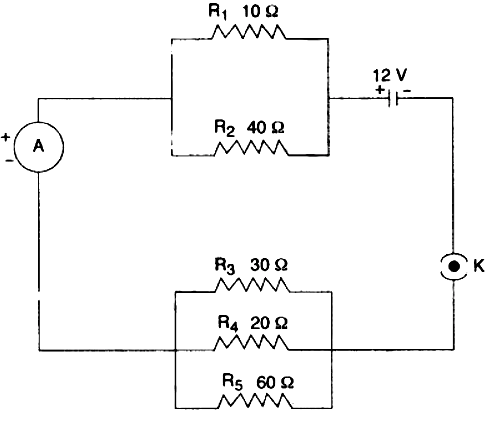
Five resistors of different resistances are connected together as shown in the figure. $A 12$ V battery is connected to the arrangement.

Calculate:
(i) the total resistance in the circuit
(ii) the total current flowing in the circuit.
Distinguish between $\alpha , \beta$ and $γ$ rays.
In an experiment of verification of Ohm’s law following observations are obtained.

potential difference V (in volt)

0.5 1.0 1.5 2.0 2.5
current I (in ampere) 0.2 0.4 0.6 0.8 1.0

Draw a characteristic V-I graph and use this graph to find:

  1. potential difference V when the current I is 0.5 A,
  2. current I when the potential difference V is 0.75 V,
  3. resistance in a circuit.
The mechanical advantage of a machine is 5 and its efficiency is $80\%$. It is used to lift a load of 200 kgf to a height of $20 m.$ Calculate:
(i) The effort required, and
(ii) The work done on the machine $(g = 10 ms^{−2}).$
Name three factors on which heat energy absorbed by a body depends and state how does it
depend on them.
(i) A piece of ice of mass 40 g is dropped into 200 g of water at $50^{\circ} C$. Calculate the final temperature of water after all the ice has melted. (specific heat capacity of water $=4200 J / kg { }^{\circ} C$, specific latent heat of fusion of ice $\left.=336 \times 10^3 H / kg \right)$
(ii) A piece of iron of mass 2.0 kg has a thermal capacity of $966 J / \circ C$.
(a) How mach heat is needed to warm it by $15^{\circ} C$ ?
(b) What is its specific heat capacity in SI units?
(iii) Explain the following :
(a) Why is water used as coolant in motor car radiators?
(b) Why it takes more time to change water at $100^{\circ} C$ to steam at $100^{\circ} C$ compared to heating same mass of water from $0^{\circ} C$ to $100^{\circ} C$ ?
State two advantages and two disadvantages of using hydro-energy for producing electricity.
A copper calorimeter of mass 50g contains 100g of water at 20°C. A metallic piece of mass 250 g is heated to 100°C and is then dropped into the calorimeter. The contents of the calorimeter are well stirred and its final highest temperature is recorded to be 28 °C. If the specific heat capacity of water is 4.2 J/g°C and of copper is 0.4 J/g°C, find:
(i) the heat gained by water,
(ii) the heat gained by calorimeter,
(iii) total heat supplied by the metal piece, and
(iv) the specific heat capacity of metal.