Question
In the context of Doppler effect in light, the term ‘red shift’ signifies (a) Decrease in frequency(b) Increase in frequency(c) Decrease in intensity(d) Increase in intensity


Answer

(a) Decrease in frequency

Need a full question paper?

Generate a complete, print-ready paper with questions like this in minutes — across 16+ boards, with answer keys.
Start Generating Free

Similar questions

Five lumen/watt is the luminous efficiency of a lamp and its luminous intensity is 35 candela. The power of the lamp is(a) 80 W (b) 176 W(c) 88 W  (d) 36 W
       
Identify the correct statement from the following.
In a sample of radioactive material, what percentage of the initial number of active nuclei will decay during one mean life(a) 69.3%  (b) 63%(c) 50%(d) 37%
       
A light beam is being reflected by using two mirrors, as in a periscope used in submarines. If one of the mirrors rotates by an angle q, the reflected light will deviate from its original path by the angle(a) 2θ(b) 0°(c)  θ(d) 4θ
       
Two capacitors of equal capacity are first connected in parallel and then in series. The ratio of the total capacities in the two cases will be(a) 2 : 1(b) 1 : 2(c) 4 : 1(d) 1 : 4
       
A parallel plate air capacitor has capacity ′C′ farad, potential ′V′ volt and energy ′E′ joule. When the gap between the plates is completely filled with dielectric.
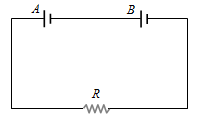
Two batteries $A$ and $B$ each of e.m.f. $2\ V$ are connected in series to an external resistance $R = 1$ ohm.  If the internal resistance of battery $A$ is $1.9$ ohms and that of$ B$ is $0.9$ ohm, what is the potential difference between the terminals of battery $A$
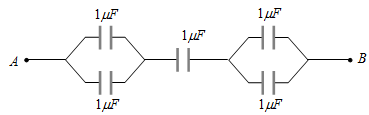
The equivalent capacitance between $A$ and $B$ is
When the separation between two charges is increased the electric potential energy of the charges.
  1. Increases.
  2. Decreases.
  3. Remains the same.
  4. May increase or decrease.
Which of the following is wrong for interference fringes?