MCQ
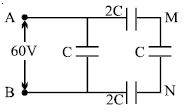
In the circuit shown, a potential difference of $60\,V$ is applied across $AB$. The potential difference between the point $M$ and $N$ is.....$V$
  • A
    $10$ 
  • B
    $15$ 
  • C
    $20$
  • $30$ 

Answer

Correct option: D.
$30$ 
d
In series combination potential divides in inverse ration of capacity

$V_{1}: V_{2}: V_{3}=\frac{1}{2 C}: \frac{1}{C}: \frac{1}{2 C}$

$V_{1}: V_{2}: V_{3}=\frac{1}{2}: \frac{1}{2}: \frac{1}{2}$

$V_{1}: V_{2}: V_{3} \equiv 1: 2: 1$

$V_{2}=\frac{2}{4} \times 60 V=30 V$

Need a full question paper?

Generate a complete, print-ready paper with questions like this in minutes — across 16+ boards, with answer keys.
Start Generating Free

Similar questions

A slit of width a is illuminated by white light. For red light (λ = 6500 Å), the first minima is obtained at θ = 30°. Then the value of a will be
The number of turns in the coil of an ac­ generator is 5000 and the area of the coil is $0.25 \mathrm{~m}^2$. The coil is rotated at the rate of 100 cycles/sec in a magnetic field of $0.2 \mathrm{~W} / \mathrm{m}^2$. The peak value of the emf generated is nearly
$A$ coil of inductance $5\,H$ is joined to a cell of $emf$ $6\,V$ through a resistance $10\,\Omega$ at time $t = 0$. The emf across the coil at time $t =$ ln $\sqrt 2\, s$ is:....$V$
What happens to the wavelength of a photon after it collides with an electron?
A particle of mass $m$ carrying charge $q$ is accelerated by a potential difference $V$. It enters perpendicularly in a region of uniform magnetic field $B$ and executes circular arc of radius $R$, then $\frac{q}{m}$ equals
Which of the following phenomenon can explain quantum nature of light:
A convex lens is made up of three different material as shown in figure. For a point object placed on its axis. The number of images formed are
What is the modulation index of an over modulated wave
A photon collides with a stationary hydrogen atom in ground state inelastically. Energy of the colliding photon is $10.2 \ eV$. After a time interval of the order of micro second another photon collides with same hydrogen atom inelastically with an energy of $15 \ eV$. What will be observed by the detector
$A$ screen is placed $90\, cm$ from a object. The image of an object on the screen is formed by a convex lens at two different locations separated by $20\, cm$.  if the size of the image formed at the positions are $6 \,cm$ and $3\, cm$, then the highest of the object is.....$cm$