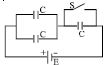
In the circuit shown, each capacitor has a capacitance $C$. The emf of the cell is $E$. If the switch $S$ is closed
Advanced
Download our app for free and get started
When $S$ is open, the all capacitors will charge.
$C_{e q}=\frac{C(C+C)}{C+(C+C)}=\frac{2}{3} C$
and $Q_{e q}=C_{e q} E=\frac{2}{3} C E$
When S is closed, the capacitor $C$ on the right will not charge and positive charge will flow out of the positive terminal of cell.
now $C_{e q}^{\prime}=C+C=2 C$ and $Q_{e q}^{\prime}=C_{e q}^{\prime} E=2 C E$
The charge flow through the cell $=Q_{e q}^{\prime}-Q_{e q}=2 C E-\frac{2}{3} C E=\frac{4}{3} C E$

Download our appand get started for free
Experience the future of education. Simply download our apps or reach out to us for more information. Let's shape the future of learning together!No signup needed.*
Similar Questions
- 1Two condensers of capacities $2C$ and $C$ are joined in parallel and charged upto potential $V$. The battery is removed and the condenser of capacity $C$ is filled completely with a medium of dielectric constant $K$. The $p.d.$ across the capacitors will now beView Solution
- 2A charge $Q$ is distributed over three concentric spherical shell of radii $a, b, c (a < b < c)$ such that their surface charge densities are equal to one another. The total potential at a point at distance $r$ from their common centre, where $r < a$, would beView Solution
- 3View SolutionAssertion : The electrostatic force between the plates of a charged isolated capacitor decreases when dielectric fills whole space between plates.
Reason : The electric field between the plates of a charged isolated capacitance increases when dielectric fills whole space between plates.
- 4A particle has a mass $400$ times than that of the electron and charge is double than that of a electron. It is accelerated by $5\,V$ of potential difference. Initially the particle was at rest, then its final kinetic energy will be......$eV$View Solution
- 5The capacity of a parallel plate condenser is $10\,\mu \,F$, when the distance between its plates is $8 \,cm$. If the distance between the plates is reduced to $4\, cm$, then the capacity of this parallel plate condenser will be.........$\mu \,F$View Solution
- 6Positive and negative point charges of equal magnitude are kept at $\left(0,0, \frac{a}{2}\right)$ and $\left(0,0, \frac{-a}{2}\right)$, respectively. The work done by the electric field when another positive point charge is moved from $(-a, 0,0)$ to $(0, a, 0)$ isView Solution
- 7The distance between the plates of a parallel plate condenser is $8\,mm$ and $P.D.$ $120\;volts$. If a $6\,mm$ thick slab of dielectric constant $6$ is introduced between its plates, thenView Solution
- 8An elementary particle of mass $m$ and charge $ + e$ is projected with velocity $v$ at a much more massive particle of charge $Ze,$ where $Z > 0.$What is the closest possible approach of the incident particleView Solution
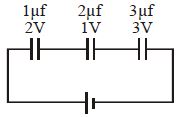
- 9The diagram shows three capacitors with their capacitances and with breakdown voltages. What should be the maximum value of external $emf$ of source such that no capacitor breaks downView Solution
- 10Two isolated conducting spheres $S_{1}$ and $S_{2}$ of radius $\frac{2}{3} R$ and $\frac{1}{3} R$ have $12\, \mu C$ and $-3\, \mu C$ charges, respectively, and are at a large distance from each other. They are now onnected by a conducting wire. A long time after this is done the charges on $S_{1}$ and $S_{2}$ are respectivelyView Solution