MCQ
In the circuit shown here, at which point is the current least?
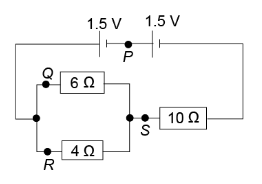
- AP
- BQ
- CR
- DS
Explanation:
Current flowing through S is the combined current from Q and R.
Current flowing through S is the same as the current from through P.
Current follows the path of least resistance.
Hence more current would flow through the 4ohm resistor.
Generate a complete, print-ready paper with questions like this in minutes — across 16+ boards, with answer keys.
In a PN-junction diode not connected to any circuit
|
(a) The potential is the same everywhere |
|
(b) The P-type is a higher potential than the N-type side |
|
(c) There is an electric field at the junction directed from the N- type side to the P- type side |
|
(d) There is an electric field at the junction directed from the P-type side to the N-type side |
From the graph between current I and voltage V shown below, identify the portion corresponding to negative resistance

|
(a) AB |
(b) BC |
(c) CD |
(d) DE |
A rocket is going towards moon with a speed v. The astronaut in the rocket sends signals of frequency v towards the moon and receives them back on reflection from the moon. What will be the frequency of the signal received by the astronaut (Take v << c)
|
(a) |
(b) |
(c) |
(d) |
Select the right option in the following
|
(a) Christian Huygens a contemporary of Newton established the wave theory of light by assuming that light waves were transverse |
|
(b) Maxwell provided the compelling theoretical evidence that light is transverse wave |
|
(c) Thomas Young experimentally proved the wave behaviour of light and Huygens assumption |
|
(d) All the statements give above, correctly answers the question “what is light” |
A parallel plate capacitor is first charged and then a dielectric slab is introduced between the plates. The quantity that remains unchanged is
|
(a) Charge Q |
(b) Potential V |
(c) Capacity C |
(d) Energy U |
Barrier potential of a P-N junction diode does not depend on
|
(a) Temperature |
(b) Forward bias |
(c) Doping density |
(d) Diode design |
Consider four circuits shown in the figure below. In which circuit power dissipated is greatest (Neglect the internal resistance of the power supply)
|
(a)
|
(b)
|
(c)
|
(d)
|


