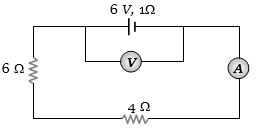
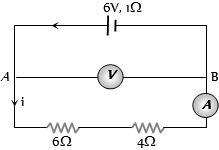
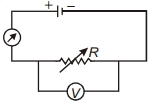
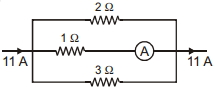
In the circuit shown here, the readings of the ammeter and voltmeter are
Medium


Download our appand get started for free
Experience the future of education. Simply download our apps or reach out to us for more information. Let's shape the future of learning together!No signup needed.*
Similar Questions
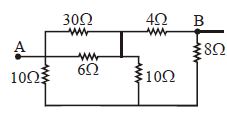
- 1The equivalent resistance across $AB$ would be ............ $\Omega$View Solution
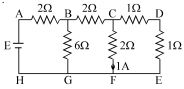
- 2The figure shows a network of resistors and $a$ battery. If $1\,A$ current flowsthrough the branch $CF$, then answer the following questions The current throughView Solution
- 3A uniform heating wire of resistance $36\, \Omega$ is connected across a potential difference of $240\, {V}$ The wire is then cut into half and potential difference of $240\, {V}$ is applied across each half separately. The ratio of power dissipation in first case to the total power dissipation in the second case would be $1: {x}$, where ${x}$ is........... .View Solution
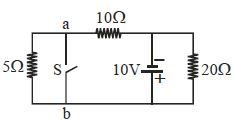
- 4In the circuit shown below, the current that flows from $a$ to $b$ when the switch $S$ is closed ............... $A$View Solution
- 5The current density in a cylindrical wire of radius $4 \; mm$ is $4 \times 10^{6} \; Am ^{-2}$. The current through the outer portion of the wire between radial distance $\frac{R}{2}$ and $R$ is $\dots \; \pi A .$View Solution
- 6Two wires of resistance $R_1$ and $R_2$ have temperature coefficient of resistance ${\alpha _1\,}{\rm{ and \,}}{\alpha _2}$, respectively. These are joined in series. The effective temperature coefficient of resistance isView Solution
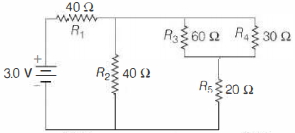
- 7In the circuit shown below, the resistances are given (in $\Omega$ ) and the battery is assumed ideal with emf equal to $3.0 \,V$. The resistor that dissipates the most power isView Solution
- 8A voltmeter is connected in parallel with a variable resistance $R$ which is in series with an ammeter and a cell as shown in the figure. For one value of $R$, the meters read $0.3 \,A$ and $0.9 \,V$. For another value of $R$ the readings are $0.25 \,A$ and $1.0 \,V$. What is the internal resistance of the cell is ......... $\Omega$View Solution
- 9The ammeter reading in the circuit below is .............. $A$View Solution
- 10The charge supplied by source varies with time $'t'$ as $Q = at -bt^2$. The total heat produced in the resistor $2R$ before current reduces to zeroView Solution