MCQ
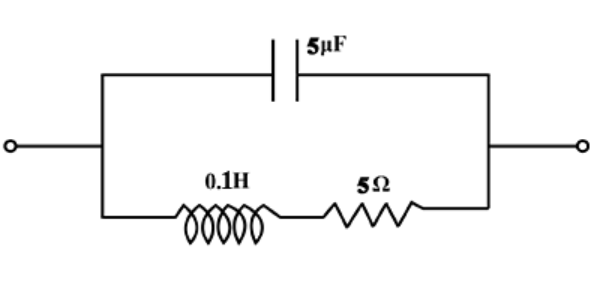
In the circuit shown in fig., the resonant frequency is.
- A200Hz
- B220Hz
- C225.08Hz
- D230Hz
Explanation:
The resonant frequecy of a circuit is given by $\text{f}=\frac{1}{2\pi\sqrt{\text{LC}}}$
Given $\text{L}=0.1\text{H }\text{C}=5\mu\text{F }\text{R}=5\Omega$
Substituting them in formula for f gives
f = 225.08 Hz.
Generate a complete, print-ready paper with questions like this in minutes — across 16+ boards, with answer keys.
In an inductor of inductance L = 100 mH, a current of I = 10A is flowing. The energy stored in the inductor is
|
(a) 5 J |
(b) 10 J |
(c) 100 J |
(d) 1000 J |
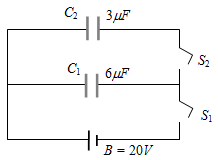
In the circuit shown here  and battery B = 20V. The switch
  is first closed. It is then opened and afterwards
  is closed. What is the charge finally on
|
(a) 120 μC |
(b) 80 μC |
(c) 40 μC |
(d) 20 μC |
According to Bohr's model, the radius of the second orbit of helium atom is
|
(a) 0.53 Å |
(b) 1.06 Å |
(c) 2.12 Å |
(d) 0.265 Å |
The mutual characteristic curves of a triode are as shown in figure. The cut off voltage for the triode is
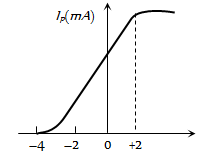
| (a) 0 V | (b) 2 V | (c) – 4 V | (d) 6 V |
If two streams of protons move parallel to each other in the same direction, then they
|
(a) Do not exert any force on each other |
|
(b) Repel each other |
|
(c) Attract each other |
|
(d) Get rotated to be perpendicular to each other |
A wave can transmit ...... from one place to another
|
(a) Energy |
(b) Amplitude |
(c) Wavelength |
(d) Matter |