MCQ
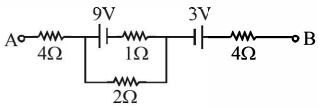
In the circuit shown in figure potential difference between points A and $B$ is $16\,V$. the current passing through $2 \Omega$ resistance will be $...........\,A$
  • A
    $2.5$
  • $3.5$
  • C
    $4.0$
  • D
    $0$

Answer

Correct option: B.
$3.5$
b
(b)

$\therefore 4 i _1+2\left( i _1+ i _2\right)-3+4 i _1=16\, V$

Using Kirchhoff's second law in the closed loop we have

$9-i_2-2\left(i_1+i_2\right)=0$

Solving equations $(i)$ and $(ii)$, we get $i _1=1.5 A ^{\text {and } i _2}=2 A$

$\therefore$ current through $2 W$ resistor $=2+1.5=3.5\,A$.

Need a full question paper?

Generate a complete, print-ready paper with questions like this in minutes — across 16+ boards, with answer keys.

Start Generating Free

Similar questions

Two similar thin equi-convex lenses, of focallength feach, are kept coaxially in contact with each other such that the focallength of the combination is $\mathrm{F}_{1}$. When the space between the two lenses is filled with gyoern(which has the same refractive index ( $\mu =1.5$ ) as that of glass then the equivalent focal length is $\mathrm{F}_{2} .$ The ratio $\mathrm{F}_{1}: \mathrm{F}_{2}$ will be


A voltmeter having resistance of $50 × 10^3$ $Omega$ is used to measure the voltage in a circuit. To increase the range of measurement $3$ times the additional series resistance required is
The temperature of an ideal gas in $3-$dimensions is $300\, {K}$. The corresponding de-Broglie wavelength of the electron approximately at $300\,{K}$, is $....\,nm$

$\left\lfloor{m}_{e}=\text { mass of electron }=9 \times 10^{-31} \,{kg}\right.$

${h}=\text { Planck constant }=6.6 \times 10^{-34} {Js}$

$\left.{k}_{{B}}=\text { Boltzmann constant }=1.38 \times 10^{-23}\, {JK}^{-1}\right]$
Assertion : In process of photoelectric emission, all emitted electrons do not have same kinetic energy.
Reason : If radiation falling on photosensitive surface of a metal consists of different wavelength then energy acquired by electrons absorbing photons of different wavelengths shall be different.
In the circuit shown in figure, all cells are ideal. The current through $2 \,\Omega$ resistor is ............ $A$
Through two parallel wires $A$ and $B$, $10$ and $2$ $ampere$ of currents are passed respectively in opposite direction. If the wire $A$ is infinitely long and the length of the wire $B$ is $ 2\, m$, the force on the conductor $B$, which is situated at $10\, cm$ distance from $A$ will be
Two photons, each of energy $2.5 eV$ are simultaneously incident on the metal surface. If the work function of the metal is $4.5 eV$, then from the surface of the metal:
The length of the wire is doubled. Its conductance will be
A particle is moving with velocity $\overrightarrow{ v }=\hat{ i }+3 \hat{ j }$ and it produces an electric field at a point given by $\overrightarrow{ E }=2 \hat{ k }$. It will produce magnetic field at that point equal to (all quantities are in SI units) 
What is the equivalent resistance between $A$ and $B$ in the figure below if $R = 3\,\Omega $