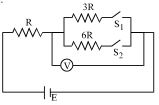
In the circuit shown in figure reading of voltmeter is $V_1$ when only $S_1$ is closed, reading of voltmeter is $V_2$ when only $S_2$ is closed. The reading of voltmeter is $V_3$ when both $S_1$ and $S_2$ are closed then
Diffcult
Download our app for free and get started
When $S_{1}$ is closed
$V_{1}=3 R \times \frac{E}{4 R}=\frac{3}{4} E$
$V_{2}=6 R \times \frac{E}{7 R}=\frac{6}{7} E$
$V_{3}=2 R \times \frac{E}{3 R}=\frac{2}{3} E$
$\mathrm{V}_{2}>\mathrm{V}_{1}>\mathrm{V}_{3}$

Download our appand get started for free
Experience the future of education. Simply download our apps or reach out to us for more information. Let's shape the future of learning together!No signup needed.*
Similar Questions
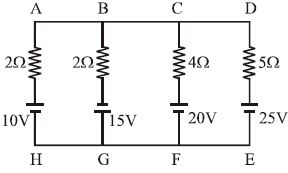
- 1In the given network current through branch $BG$ is almost equal to ............ $A$View Solution
- 2For a metallic wire, the ratio $V/i$ ($V = $ the applied potential difference, $i$ = current flowing) isView Solution
- 3Ratio of thermal energy released in two resistor $R$ and $3 R$ connected in parallel in an electric circuit is :View Solution
- 4View SolutionIt is easier to start a car engine on a hot day than on a cold day. This is because the internal resistance of the car battery
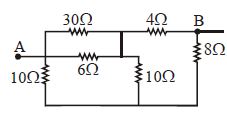
- 5The equivalent resistance across $AB$ would be ............ $\Omega$View Solution
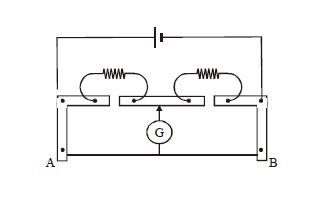
- 6A meter bridge set up as shown to determine end correction at $A$ and $B$. When a resistance of $15\ \Omega$ is used in left gap and of $20\ \Omega$ in right gap, then null point comes at a distance $42\ cm$ from $A$. When these resistances are interchanged null point comes at a distance $57\ cm$ from $A$. Values of end corrections areView Solution
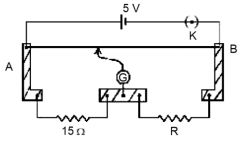
- 7A meter bridge setup is shown in the figure. It is used to determine an unknown resistance $R$ using a given resistor of $15\,\Omega$. The galvanometer $(G)$ shows null deflection when tapping key is at $43\,cm$ mark from end $A$. If the end correction for end $A$ is $2\,cm$. then the determined value of $R$ will be__________ $\Omega$View Solution
- 8A strip of copper and another of germanium are cooled from room temperature to $80\, K$. The resistance ofView Solution
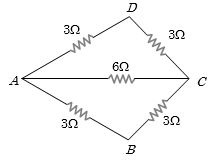
- 9The effective resistance between the points $A$ and $B$ in the figure is ............. $\Omega$View Solution
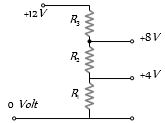
- 10A potential divider is used to give outputs of $4\, V$ and $8\, V$ from a $12\, V$ source. Which combination of resistances, $(R_1, R_2, R_3)$ gives the correct voltages ? $R_1 : R_2 : R_3$View Solution