It is easier to start a car engine on a hot day than on a cold day. This is because the internal resistance of the car battery
Easy


Download our appand get started for free
Experience the future of education. Simply download our apps or reach out to us for more information. Let's shape the future of learning together!No signup needed.*
Similar Questions
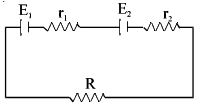
- 1Under what condition current passing through the resistance $R$ can be increased by short circuiting the battery of emf $E_2$. The internal resistances of the two batteries are $r_1$ and $r_2$ respectively.View Solution
- 2When a resistance of $2\, ohm$ is connected across the terminals of a cell, the current is $0.5\, A$. When the resistance is increased to $5\, ohm$, the current is $0.25\, A$. The $e.m.f.$ of the cell is ................. $V$View Solution
- 3A potentiometer consists of a wire of length $4\, m$ and resistance $10 \,\Omega$. It is connected to cell of $emf$ $2\, V$. The potential difference per unit length of the wire will be ............ $V/m$View Solution
- 4In the circuit shown $E, F, G$ and $H$ are cells of $\mathrm{e.m.f.}$ $2\,V, 1\,V, 3\,V$ and $1\,V$ respectively and their internal resistances are $2\,\Omega , 1\,\Omega , 3\,\Omega$ and $1\,\Omega$ respectively.View Solution
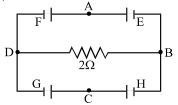
- 5The potential difference between $A$ and $B$ in the Figure is ................. $V$View Solution

- 6A car battery of $e.m.f$. $12\,V$ and internal resistance $5 \times {10^{ - 2}}\,\Omega $, receives a current of $60\; A$ from external source, then terminal voltage of battery isView Solution
- 7A wire $100\,cm$ long and $2.0\,mm$ diameter has a resistance of $0.7\, ohm$, the electrical resistivity of the material is ...........$ \times {10^{ - 6}}\,ohm \times m$View Solution
- 8$n$ identical cells are joined in series with two cells $A$ and $B$ with reversed polarities. $emf$ of each cell is $E$ and internal resistance is $r$. Potential difference across cell $A$ and $B$ is : $(n > 4)$View Solution
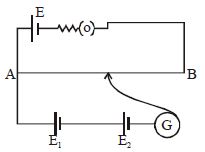
- 9In given arrangement $E_1 = 5\, volts$ $E_2 = 7\, volt$ balancing length is $6\,m$ if terminals of $E_2$ are reversed then new balancing length will beView Solution
- 10A storage cell is charged by $5\, amp$ $D.C.$ for $18$ hours. Its strength after charging will be .............. $AH$View Solution