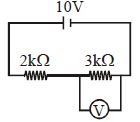
In the circuit shown in figure, the resistance of voltmeter is $6\, k\Omega $. The voltmeter reading will be ................. $\mathrm{V}$
Medium
Download our app for free and get started
$\mathrm{R}=\frac{3 \times 6}{3+6}=2 \mathrm{\,K} \Omega$
voltage reading:
$\mathrm{V}=\frac{2}{2+2} \times 10=5 \mathrm{\,Volt}$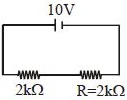

Download our appand get started for free
Experience the future of education. Simply download our apps or reach out to us for more information. Let's shape the future of learning together!No signup needed.*
Similar Questions
- 1View SolutionWhich of the following statements is false?
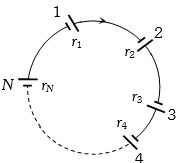
- 2A group of $N$ cells whose $emf$ varies directly with the internal resistance as per the equation $E_N = 1.5\, r_N$ are connected as shown in the figure below. The current $I$ in the circuit is ........... $amp$View Solution
- 3View SolutionWhich of the following has a negative temperature coefficient
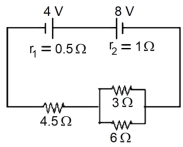
- 4In the circuit diagram shown in figure given below, the current flowing through resistance $3\, \Omega$ is $\frac{ x }{3}\,A$. The value of $x$ is $...........$View Solution
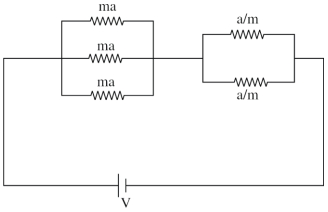
- 5In the given circuit ' $a$ ' is an arbitrary constant. The value of $m$ for which the equivalent circuit resistance is minimum, will be $\sqrt{\frac{ x }{2}}$. The value of $x$ is ...........View Solution
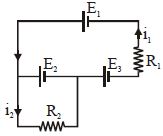
- 6The current $i_1$ and $i_2$ through the resistor $R_1 (= 10\,\Omega )$ and $R_2 (=30 \,\Omega )$ in the circuit diagram with $E_1 = 3\,V, E_2 = 3\,V$ and $E_3 = 2\,V$ are respectively:View Solution
- 7The same mass of copper is drawn into two wires $1\, mm$ and $2\, mm$ thick. Two wires are connected in series and current is passed through them. Heat produced in the wire is in the ratioView Solution
- 8$E$ denotes electric field in a uniform conductor, $I$ corresponding current through it, ${v_d}$ drift velocity of electrons and $P$ denotes thermal power produced in the conductor, then which of the following graph is incorrectView Solution
- 9If $n,\,e,\,\tau $ and $m$ respectively represent the density, charge relaxation time and mass of the electron, then the resistance of a wire of length $l$ and area of cross-section $A$ will beView Solution
- 10A battery of $24$ cells, each of emf $1.5\, V$ and internal resistance $2\, \Omega$ is to be connected in order to send the maximum current through a $12 \,\Omega$ resistor. The correct arrangement of cells will beView Solution