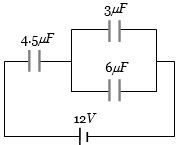
In the circuit shown in the figure, the potential difference across the $4.5\,\mu F$ capacitor is.......$volts$
Medium
Download our app for free and get started
(d) The given circuit can be redrawn as follows potential difference across $4.5 \,\mu F$ capacitor
$V = \frac{9}{{\left( {\frac{9}{2} + 9} \right)}} \times 12$
$= 8\, V$
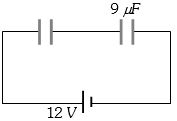
$V = \frac{9}{{\left( {\frac{9}{2} + 9} \right)}} \times 12$
$= 8\, V$

Download our appand get started for free
Experience the future of education. Simply download our apps or reach out to us for more information. Let's shape the future of learning together!No signup needed.*
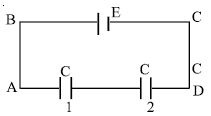
Similar Questions
- 1A point charge $Q$ is placed in uniform electric field $\vec E = E_1 \hat i + E_2\hat j$ at position $(a, b)$. Find work done in moving it to position $(c, d)$View Solution
- 2A $4\ \mu F$ capacitor, a resistance of $2.5 \,MW$$\Omega$ is in series with $12\, V$ battery. Find the time after which the potential difference across the capacitor is $3$ times the potential difference across the resistor.......$s$ [Given $ln(2)= 0.693$]View Solution
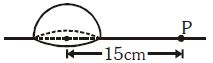
- 3Figure shows a solid hemisphere with a charge of $5\ nC$ distributed uniformly through its volume. The hemisphere lies on a plane and point $P$ is located on this plane, along a radial line from the centre of curvature at distance $15\ cm$. The electric potential at point $P$ due to the hemisphere, is .....$V$View Solution
- 4$S_1$ and $S_2$ are two equipotential surfaces on which the potentials are not equal. Which of the statement is incorrect ?View Solution
- 5Two charges $ + 3.2 \times {10^{ - 19}}\,C$ and $ - 3.2 \times {10^{ - 19}}\,C$ kept $2.4\, \mathop A\limits^o $ apart forms a dipole. If it is kept in uniform electric field of intensity $4 \times {10^5}\,volt/m$ then what will be its electrical energy in equilibriumView Solution
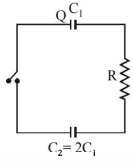
- 6Two capacitors $C_1$ and $C_2=$ $2 C _1$ are connected in a circuit with a switch between them as shown in the figure.Initially the switch is open and $C _1$ holds charge $Q$. The switch is closed. At steady state, the charge on each capacitor will beView Solution
- 7A parallel plate capacitor of capacitance $C$ has spacing $d$ between two plates having area $A$. The region between the plates is filled with $N$ dielectric layers, parallel to its plates, each with thickness $\delta=\frac{ d }{ N }$. The dielectric constant of the $m ^{\text {th }}$ layer is $K _{ m }= K \left(1+\frac{ m }{ N }\right)$. For a very large $N \left(>10^3\right)$, the capacitance $C$ is $\alpha\left(\frac{ K \varepsilon_0 A }{ d \;ln 2}\right)$. The value of $\alpha$ will be. . . . . . . .View Solution
[ $\in_0$ is the permittivity of free space]
- 8View SolutionWhen one electron is taken towards the other electron, then the electric potential energy of the system
- 9The work done in carrying a charge of $5\,\mu \,C$ from a point $A$ to a point $B$ in an electric field is $10\,mJ$. The potential difference $({V_B} - {V_A})$ is thenView Solution
- 10In the adjoining figure, capacitor $(1)$ and $(2)$ have a capacitance $‘C’$ each. When the dielectric of dielectric consatnt $K$ is inserted between the plates of one of the capacitor, the total charge flowing through battery isView Solution