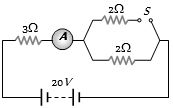
In the circuit shown, the reading of ammeter when switch $S$ is open and when switch $S$ is closed respectively are
Medium


Download our appand get started for free
Experience the future of education. Simply download our apps or reach out to us for more information. Let's shape the future of learning together!No signup needed.*
Similar Questions
- 1In the experiment of calibration of voltmeter, a standard cell of $e.m.f\,\,1.1\,volt$ is balanced against $440\,cm$ of potential wire. The potential difference across the ends of resistance is found to balance against $220\,cm$ of the wire. The corresponding reading of voltmeter is $0.5\,volt.$ The error in the reading of volmeter will be .................. $volt$View Solution
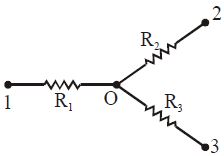
- 2.............. $A$ the current flowing through the resistance $R_2$ of the circuit shown in fig if the resistance are equal to $R_1 = 20\ \Omega, R_2 = 30 \ \Omega$ and $R_3 = 60 \ \Omega$ and potentials of points $1, 2$ and $3$ are equal to $V_1= 20\, V,$ $V_2 = 30\ V$ and $V_3 = 60\ V$View Solution
- 3A potentiometer is an accurate and versatile device to make electrical measurements of $EMF$ because the method involvesView Solution
- 4Find charge on the capacitor after $1$ sec of opening the switch at $t=\infty ?$View Solution
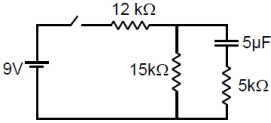
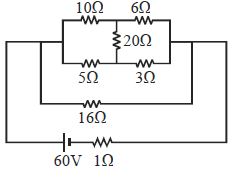
- 5The current from the cell for the given circuit is ................ $\mathrm{A}$View Solution
- 6The effective resistance of a parallel connection that consists of four wires of equal length, equal area of cross-section and same material is $0.25\, \Omega$. What will be the effective resistance if they are connected in series ? (In $\Omega$)View Solution
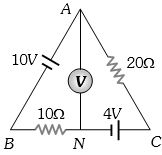
- 7The reading of the ideal voltmeter in the adjoining diagram will be ................. $V$View Solution
- 8The same mass of copper is drawn into two wires $1\, mm$ and $2\, mm$ thick. Two wires are connected in series and current is passed through them. Heat produced in the wire is in the ratioView Solution
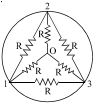
- 9Inside $a$ super conducting ring six identical resistors each of resistance $R$ are connected as shown in figure. The equivalent resistance $(s)$View Solution
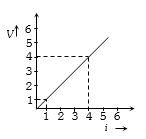
- 10Variation of current and voltage in a conductor has been shown in the diagram below. The resistance of the conductor is. ........... $ohm$View Solution