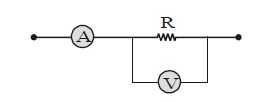
In the circuit shown the readings of ammeter and voltmeter are $4\,\, A$ and $20\,\, V$ respectively. The meters are non ideal, then $R$ is
Medium
Download our app for free and get started
Measured value of $R\, = \,\frac{V}{I} = \frac{{20}}{4}\, = 5\,\Omega $ But current in $R$ will actually be less than $I,$ so $R$ should be greater than $5\,\Omega $

Download our appand get started for free
Experience the future of education. Simply download our apps or reach out to us for more information. Let's shape the future of learning together!No signup needed.*
Similar Questions
- 1An electric bulb rated $50 \mathrm{~W}-200 \mathrm{~V}$ is connected across a $100 \mathrm{~V}$ supply. The power dissipation of the bulb is :View Solution
- 2$3$ identical bulbs are connected in series and these together dissipate a power $P$. If now the bulbs are connected in parallel, then the power dissipated will beView Solution
- 3The Kirchhooff's first law $\left(\sum i=0\right)$ and second law ( $\left.\sum i R=\sum E\right)$, where the symbols have their usual meanings, are respectively based onView Solution
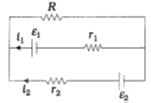
- 4View SolutionSee the electrical circuit shown in this figure. Which of the following equations is a correct equation for it ?
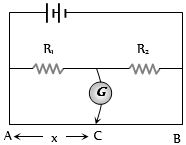
- 5In the shown arrangement of the experiment of the meter bridge if $AC$ corresponding to null deflection of galvanometer is $x$, what would be its value if the radius of the wire $AB$ is doubledView Solution
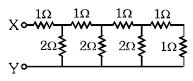
- 6Net resistance of the given circuit between $X$ and $Y$ is ............... $\Omega$View Solution
- 7In a region $10^{19}$ $\alpha -$ particels and $10^{19}$ protons per second move to the left, while $10^{19}$ electrons moves to the right per second. The current isView Solution
- 8Four wires of equal length and of resistances $10$ $ ohms$ each are connected in the form of a square. The equivalent resistance between two opposite corners of the square is ............. $ohm$View Solution
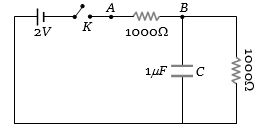
- 9When the key $K$ is pressed at time $t = 0$, which of the following statements about the current $I$ in the resistor $AB$ of the given circuit is trueView Solution
- 10Resistance in the two gaps of a meter bridge are $10\, ohm$ and $30\, ohm$ respectively. If the resistances are interchanged the balance point shifts by.............. $cm$View Solution