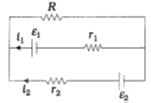
See the electrical circuit shown in this figure. Which of the following equations is a correct equation for it ?
AIPMT 2009, Medium
Download our app for free and get started
Applying Kirchhoff's equation to the loop $A B F E$,
$-\left(i_{1}+i_{2}\right) R-i_{1} r_{1}+\varepsilon_{1}=0$
or $\quad \varepsilon_{1}-\left(i_{1}+i_{2}\right) R-i_{1} r_{1}=0$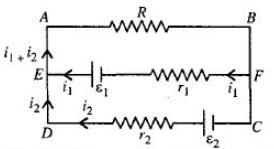

Download our appand get started for free
Experience the future of education. Simply download our apps or reach out to us for more information. Let's shape the future of learning together!No signup needed.*
Similar Questions
- 1A wire of diameter $0.02\,meter$ contains $10^{28}$ free electrons per cubic meter. For an electrical current of $100\, A$, the drift velocity of the free electrons in the wire is nearlyView Solution
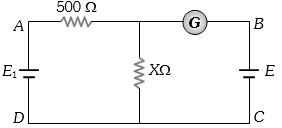
- 2If ${R_1}$ and ${R_2}$ are respectively the filament resistances of a $200$ $watt$ bulb and $100$ $watt$ bulb designed to operate on the same voltage, thenView Solution
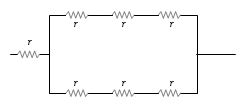
- 3View SolutionReferring to the figure below, the effective resistance of the network is
- 4In a building there are $15$ bulbs of $45\; \mathrm{W}, 15$ bulbs of $100\; \mathrm{W}, 15$ small fans of $10 \;\mathrm{W}$ and $2$ heaters of $1 \;\mathrm{kW}$. The voltage of electric main is $220\; \mathrm{V}$. The minimum fuse capacity (rated value) of the building will be: .......... $A$View Solution
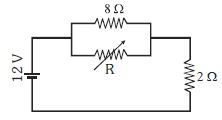
- 5The value of the resistance $R$ in figure is adjusted such that power dissipated in the $2\,\Omega $ resistor is maximum. Then the power dissipated in the $2\,\Omega $ will be ................ $W$View Solution
- 6A certain wire has a resistance $R$. The resistance of another wire identical with the first except having twice its diameter isView Solution
- 7A cylindrical metal wire of length $l$ and cross sections area $S$, has resistance $R$, conductance $G$, conductivity $\sigma$ and resistivity $\rho$. Which one of the following expressions for $\sigma$ is validView Solution
- 8View SolutionA steady current flows in a metallic conductor of non-uniform cross-section. The quantity/quantities constant along the length of the conductor is/are
- 9Two electric bulbs marked $40\,W,$ $220\,V$ and $60\,W,\,\,220\,V$ when connected in series across same voltage supply of $220\,V,$ the effective power is $P_1$ and when connected in parallel, the effective power is $P_2.$ Then $\frac {P_1}{P_2}$ isView Solution
- 10In the adjoining circuit, the battery ${E_1}$ has an $e.m.f.$ of $12\,volt$ and zero internal resistance while the battery $E$ has an $e.m.f.$ of $2\,volt$. If the galvanometer $G$ reads zero, then the value of the resistance $X$ in $ohm$ isView Solution