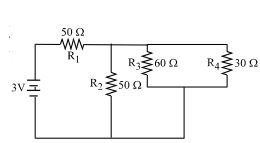
In the circuit shown, the resistances are given in ohms and the battery is assumed ideal with $\mathrm{emf}$ equal to $3.0$ $\mathrm{volts}.$ The resistor that dissipates the most power is
Advanced
Download our app for free and get started
Power is related to current and resistance by $P=I^{2} R \quad .$ The resistor that has
the most current would be $R_{1}$.
since all the other resistor share a current that is split from the main current running from battery to $R_{1}$
since $R_{e q} < R_{1},$ the most power is thus dissipated through $R_{1}$

Download our appand get started for free
Experience the future of education. Simply download our apps or reach out to us for more information. Let's shape the future of learning together!No signup needed.*
Similar Questions
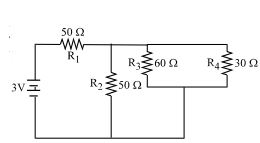
- 1In the circuit shown, the resistances are given in ohms and the battery is assumed ideal with $\mathrm{emf}$ equal to $3.0$ $\mathrm{volts}.$ The resistor that dissipates the most power isView Solution
- 2Two wires $A$ and $B $ of same material and same mass have radius $2r$ and $r$ . If resistance of wire $A$ is $34\,\Omega $, then resistance of $B$ will be ............ $\Omega$View Solution
- 3A $2\, W$ carbon resistor is color coded with green, black, red and brown respectively. The maximum current which can be passed through this resistor is .............. $mA$View Solution
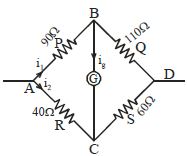
- 4In a Wheatstone bridge, $P = 90\,\Omega $, $Q = 110\,\Omega $ , $R = 40\,\Omega $ and $S = 60\,\Omega $ and a cell of $4\,V\,emf$. Then the potential difference between the diagonal along which a galvanometer is connected is ............. $V$View Solution
- 5If in the circuit shown below, the internal resistance of the battery is $1.5$ $\Omega$ and $V_P$ and $V_Q$ are the potentials at $P$ and $Q$ respectively, what is the potential difference between the points $P$ and $Q$View Solution
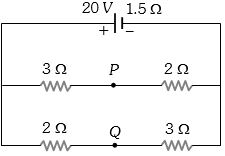
- 6When the resistance of $9 \,\Omega$ is connected at the ends of a battery, its potential difference decreases from $40\, volt$ to $30\, volt$. The internal resistance of the battery is ............... $\Omega$View Solution
- 7Calculate the current shown by the ammeter $A$ in the circuit diagram is .............. $A$View Solution
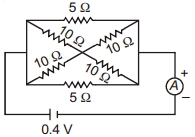
- 8View SolutionWhich of the adjoining graphs represents ohmic resistance
- 9View SolutionOf the two bulbs in a house hold circuit, one glows brighter than the other, Which of the two bulbs has a large resistance?
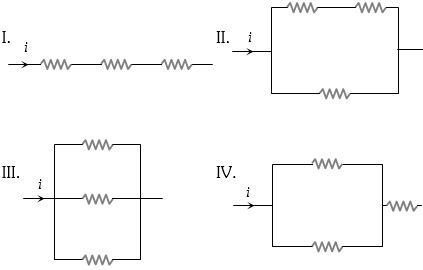
- 10View SolutionThe three resistance of equal value are arranged in the different combinations shown below. Arrange them in increasing order of power dissipation.