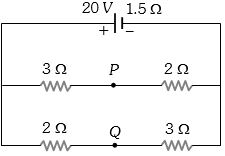
If in the circuit shown below, the internal resistance of the battery is $1.5$ $\Omega$ and $V_P$ and $V_Q$ are the potentials at $P$ and $Q$ respectively, what is the potential difference between the points $P$ and $Q$
Diffcult
Download our app for free and get started
(d) ${R_{eq}} = \frac{5}{2}\Omega $
$i = \frac{{20}}{{\frac{5}{2} + 1.5}} = 5\,A$
Potential difference between $X$ and $ P$,
${V_X} - {V_P} = \left( {\frac{5}{2}} \right) \times 3 = 7.5V$....$(i)$
${V_X} - {V_Q} = \frac{5}{2} \times 2 = 5\,V$…$(ii)$
On solving $(i)$ and $(ii)$ ${V_P} - {V_Q} = - 2.5{\rm{ }}\,volt\,{\rm{; }}{V_Q} > {V_P}$.
Short Trick : $({V_P} - {V_Q}) = \frac{i}{2}({R_2} - {R_1})$$ = \frac{5}{2}(2 - 3) = - \,2.5$
==> ${V_Q} > {V_P}$
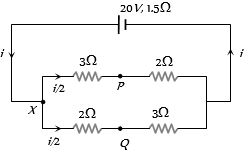
$i = \frac{{20}}{{\frac{5}{2} + 1.5}} = 5\,A$
Potential difference between $X$ and $ P$,
${V_X} - {V_P} = \left( {\frac{5}{2}} \right) \times 3 = 7.5V$....$(i)$
${V_X} - {V_Q} = \frac{5}{2} \times 2 = 5\,V$…$(ii)$
On solving $(i)$ and $(ii)$ ${V_P} - {V_Q} = - 2.5{\rm{ }}\,volt\,{\rm{; }}{V_Q} > {V_P}$.
Short Trick : $({V_P} - {V_Q}) = \frac{i}{2}({R_2} - {R_1})$$ = \frac{5}{2}(2 - 3) = - \,2.5$
==> ${V_Q} > {V_P}$

Download our appand get started for free
Experience the future of education. Simply download our apps or reach out to us for more information. Let's shape the future of learning together!No signup needed.*
Similar Questions
- 1The supply voltage to room is $120\ V$. The resistance of the lead wires is $6\,\Omega$ . A $60\ W$ bulb is already switched on. What is the decrease of voltage across the bulb, when a $240\ W$ heater is switched on in parallel to the bulb? ............. $V$View Solution
- 2An electric bulb rated $50 \mathrm{~W}-200 \mathrm{~V}$ is connected across a $100 \mathrm{~V}$ supply. The power dissipation of the bulb is :View Solution
- 3At room temperature, copper has free electron density of $8.4 \times {10^{28}}$ per ${m^3}$. The copper conductor has a cross-section of $10^{-6} \,m^2$ and carries a current of $5.4\, A$. The electron drift velocity in copper isView Solution
- 4View SolutionWhich is a wrong statement
- 5Two cells of $e.m.f.$ $E_1$ and $E_2$ are joined in series and the balancing length of the potentiometer wire is $625$ $cm$. If the terminals of $E_1$ are reversed, the balancing length obtained is $125 \,cm$. Given $E_2 > E_1$, the ratio $E_1: E_2$ will beView Solution
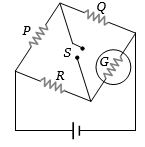
- 6The figure shows a circuit diagram of a ‘Wheatstone Bridge’ to measure the resistance $G$ of the galvanometer. The relation $\frac{P}{Q} = \frac{R}{G}$ will be satisfied only whenView Solution
- 7For what value of $R$ the net resistance of the circuit will be $18\, ohms$ ............... $\Omega$View Solution
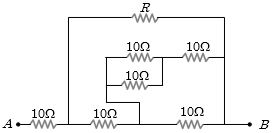
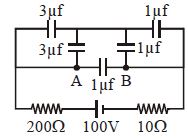
- 8Find potential difference between $A$ and $B$ in given circuit in steady state ............... $\mathrm{V}$View Solution
- 9Equivalent resistance between the adjacent corners of a regular $n$-sided polygon of uniform wire of resistance $R$ would be:View Solution
- 10A uniform wire of $16\,\Omega $ is made into the form of a square. Two opposite corners of the square are connected by a wire of resistance $16\,\Omega $. The effective resistance between the other two opposite corners is ............... $\Omega$View Solution