MCQ
In the elastic collision of objects
  • A
    Only momentum remains constant
  • B
    Only K.E. remains constant
  • Both remains constant
  • D
    None of these

Answer

Correct option: C.
Both remains constant
c
(c)

Need a full question paper?

Generate a complete, print-ready paper with questions like this in minutes — across 16+ boards, with answer keys.
Start Generating Free

Similar questions

In a sample of radioactive material, what percentage of the initial number of active nuclei will decay during one mean life .......... $\%$
Two $SHM$ are represented by equations, $y_1 = 6\cos \left( {6\pi t + \frac{\pi }{6}} \right)\,,{y_2} = 3\left( {\sqrt 3 \sin 3\pi t + \cos 3\pi t} \right)$
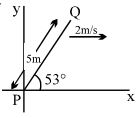
$A$ conducting rod $PQ$ of length $5\,m$ oriented as shown in figure is moving with velocity $(2\,m/s)\hat i$ without any rotation in a uniform magnetic field $(3\hat j + 4\hat k)$ Tesla. $Emf$ induced in the rod is.....$Volts$
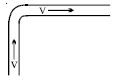
A fire hydrant delivers water of density $\rho$ at a volume rate $L$. The water travels vertically upward through the hydrant and then does $90^o $ turn to emerge horizontally at speed $V$. The pipe and nozzle have uniform crosssection throughout. The force exerted by the water on the corner of the hydrant is
The moment of inertia of a rod about an axis through its centre and perpendicular to it is $\frac{1}{{12}}\,M{L^2}$ (where $M$ is the mass and $L$, the length of the rod). The rod is bent in the middle so that the two halts make an angle of $60^o$. The moment of inertia of the bent rod about the same axis would be 
Infinite springs with force constant $k$, $2k$, $4k$ and $8k$.... respectively are connected in series. The effective force constant of the spring will be
A particle of mass $M$ is moving in a circle of fixed radius $R$ in such a way that its centripetal acceleration at time $t$ is given by $n^2Rt^2$ where $n$ is a constant. The power delivered to the particle by the force acting on it, is
If $\oint_s \vec{E} \cdot \overrightarrow{d S}=0$ over a surface, then:
Photo cells are used for the
A rod of mass $m$ and length $l$ is placed on smooth floor pivoted at its centre. A gun is mounted at one end, of mass $m$ without a shot. It fires a shot of mass $\frac{m}{{10}}$ with velocity $v$ relative to gun. The angular velocity of the rod will be