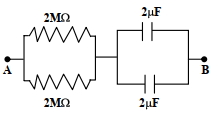
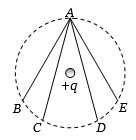
In the electric field of a point charge $q$, a certain charge is carried from point $A$ to $B$, $C$, $D$ and $E$. Then the work done
Easy


Download our appand get started for free
Experience the future of education. Simply download our apps or reach out to us for more information. Let's shape the future of learning together!No signup needed.*
Similar Questions
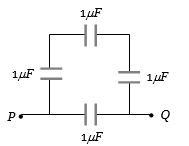
- 1Four capacitors are connected as shown in the equivalent capacitance between the points $P$ and $Q$ is.......$\mu F$View Solution
- 2A parallel plate capacitor has an electric field of ${10^5}\,V/m$ between the plates. If the charge on the capacitor plate is $1\,\mu \,C$, the force on each capacitor plate is......$N$View Solution
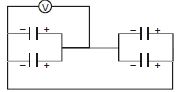
- 3The four capacitors, each of $25\,\mu \,F$ are connected as shown in fig. The $dc$ voltmeter reads $200\,V$. The charge on each plate of capacitor isView Solution
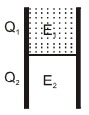
- 4A parallel plate capacitor has a dielectric slab of dielectric constant $K$ between its plates that covers $1 / 3$ of the area of its plates, as shown in the figure. The total capacitance of the capacitor is $C$ while that of the portion with dielectric in between is $C _1$. When the capacitor is charged, the plate area covered by the dielectric gets charge $Q_1$ and the rest of the area gets charge $Q_2$. Choose the correct option/options, igonoring edge effects.View Solution
$(A)$ $\frac{E_1}{E_2}=1$ $(B)$ $\frac{E_1}{E_2}=\frac{1}{K}$ $(C)$ $\frac{Q_1}{Q_2}=\frac{3}{K}$ $(D)$ $\frac{ C }{ C _1}=\frac{2+ K }{ K }$
- 5Two parallel plates separated by a distance of $5\,mm$ are kept at a potential difference of $50\,V.$ A particle of mass ${10^{ - 15}}\,kg$ and charge ${10^{ - 11}}\,C$ enters in it with a velocity ${10^7}\,m/s.$ The acceleration of the particle will beView Solution
- 6A particle of mass $100\, gm$ and charge $2\, \mu C$ is released from a distance of $50\, cm$ from a fixed charge of $5\, \mu C$. Find the speed of the particle when its distance from the fixed charge becomes $3\, m$. Neglect any other force........$m/s$View Solution
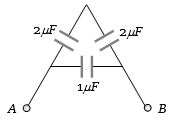
- 7What is the effective capacitance between $A$ and $B$ in the following figure........$\mu \,F$View Solution
- 8Conduction electrons are almost uniformly distributed within a conducting plate. When placed in an electrostatic field $\overrightarrow E $, the electric field within the plateView Solution
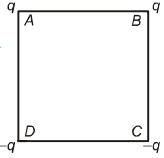
- 9Charges are placed on the vertices of a square as shown Let $\vec E$ be the electric field and $V$ the potential at the centre. If the charges on $A$ and $B$ are interchanged with those on $D$ and $C$ respectively, thenView Solution
- 10At time $\mathrm{t}=0$, a battery of $10 \mathrm{~V}$ is connected across points $\mathrm{A}$ and $\mathrm{B}$ in the given circuit. If the capacitors have no charge initially, at what time (in seconds) does the voltage across them becomes $4$ volt?View Solution
[take $\ln 5=1.6, \ln 3=1.1]$