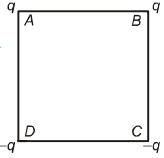
Charges are placed on the vertices of a square as shown Let $\vec E$ be the electric field and $V$ the potential at the centre. If the charges on $A$ and $B$ are interchanged with those on $D$ and $C$ respectively, then
AIEEE 2007, Easy
Download our app for free and get started
As shown in the figure, the resultant electric fields before and after interchanging the charges will have the same magnitude, but opposite directions.
Also, the potential will be same in both cases as it is a scalar quantity.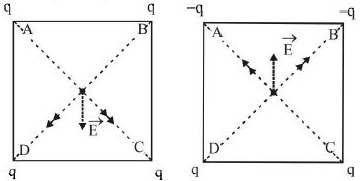

Download our appand get started for free
Experience the future of education. Simply download our apps or reach out to us for more information. Let's shape the future of learning together!No signup needed.*
Similar Questions
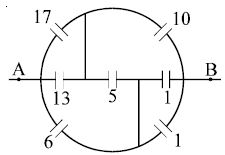
- 1Find equivalent capacitance across $AB$.....$ \mu F$ (all capacitances in $\mu F$)View Solution
- 2A parallel plate condenser is immersed in an oil of dielectric constant $2$. The field between the plates isView Solution
- 3Two identical particles of mass $m$ and charge $q$ are shot at each other from a very great distance with an initial speed $v$. The distance of closest approach of these charges isView Solution
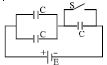
- 4In the circuit shown, each capacitor has a capacitance $C$. The emf of the cell is $E$. If the switch $S$ is closedView Solution
- 5A particle $A$ has charge $ + q$ and a particle $B$ has charge $ + \,4q$ with each of them having the same mass $m$. When allowed to fall from rest through the same electric potential difference, the ratio of their speed $\frac{{{v_A}}}{{{v_B}}}$ will becomeView Solution
- 6An electric dipole of moment $\vec p$ is kept in a uniform electric field $\vec E$. Angle between $\vec p$ and $\vec E$ is $30^o$. Calculate work done by field when angle is increased to $60^o.$View Solution
- 7The insulated spheres of radii ${R_1}$ and ${R_2}$ having charges ${Q_1}$and ${Q_2}$ respectively are connected to each other. There isView Solution
- 8A particle has a mass $400$ times than that of the electron and charge is double than that of a electron. It is accelerated by $5\,V$ of potential difference. Initially the particle was at rest, then its final kinetic energy will be......$eV$View Solution
- 9A capacitor of $4\, \mu F$ is connected to a $15\, V$ supply through $1$ mega ohm resistance. The time taken by the capacitor to charge upto $63.2\%$ of its final charge will be......$s$View Solution
- 10View SolutionThree equal charges are placed at the corners of an equilateral triangle. Which of the graphs below correctly depicts the equally-spaced equipotential surfaces in the plane of the triangle? (All graphs have the same scale.)